



Cleaning Car Seats: One Concentrate, Three Materials
Most stains in cars happen on the go — coffee, sun cream, chocolate on the back seat. And most are treated incorrectly. Not due to carelessness, but because fabric upholstery, Alcantara, and smooth leather react completely differently chemically, and most cleaners are either too aggressive or too weak.
A pH-neutral cleaner concentrate solves this problem if you adjust the dosage to the material. How this actually works in the workshop, what the COLOURLOCK Pol Star can do on three surfaces, and where it reaches its limits — here step by step, without marketing jargon.
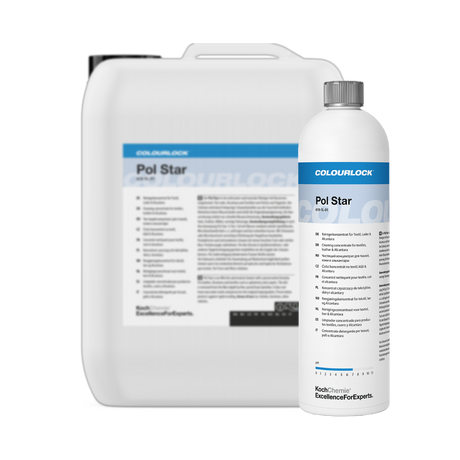
Pol Star is a pH-neutral cleaner concentrate for textiles, leather, and Alcantara
The label of the COLOURLOCK Pol Star cleaner concentrate states exactly what's inside: a pH-neutral surfactant cleaner, intended for textiles, leather, and Alcantara in the vehicle interior. Concentrate means: you dilute it before use. Ready-to-use products are often 95 percent water in a spray bottle; with a concentrate, you pay for the active ingredient, not for transport.
Its origin says a lot. COLOURLOCK is a German company from Hamburg, specializing in leather chemistry for saddlers, leather dyers, and vehicle detailers since 1979. Koch-Chemie has brought the product range into vehicle care and manages it together with COLOURLOCK. The Pol Star is the central cleaner concentrate in this line.
pH-neutral means a value around 7 — neither acidic nor alkaline. This is important because leather swells and dries out with alkaline cleaners, and coated Alcantara loses its finish with acidic cleaners. A pH-neutral surfactant cleaner stays within the window where all three materials are compatible.
The cleaning action comes from surfactant chemistry: molecules with a water-loving and a fat-loving end enclose the dirt, detach it from the fiber, and hold it in suspension until you pick it up with a microfiber cloth. Without mechanical brushing, the dissolved dirt remains in the fiber — brushing is just as important as chemistry. Those who underestimate this will wonder in the end why the stain is still there.
How to dose correctly: 1:10 for upholstery, 1:20 for leather
The dosage is the only lever that determines whether the cleaner acts too weakly or too aggressively. Three dilution levels cover almost everything that occurs in the car.
For normally soiled fabric upholstery, dilute 1:10 with distilled water. This means: 100 ml concentrate to one liter. Distilled water is used because tap water in many regions contains lime — which remains as a gray film on dark fabric after drying.
Smooth leather works with 1:20, half as strong, because the surface is sealed and the cleaner should only remove surface dirt, not attack the sealant. For stubborn stains — dried coffee, make-up, sun cream on the headliner — you go to 1:5. It won't be more concentrated than that, otherwise residue will form.
The process itself is simpler than most tutorials make it. First, vacuum thoroughly — sand and dust are the enemies of any wet cleaning. Then apply the mixture with a sprayer or pump bottle to the soiled area until it is visibly damp, but not soaked.
Let it sit for three to four minutes, do not let it dry. Lather with an upholstery brush or a soft nylon hand brush in small circular motions. A slightly damp microfiber cloth absorbs the dissolved dirt and cleaning agent — the cloth will become noticeably dirty, which is the sign of successful removal.

Three materials, same bottle, measurable results
Detailing1-Insight: The fingernail method tells you in two seconds what you have under your fingers. Alcantara is a very densely woven microfiber velour fabric and hardly springs back when pressed with a fingernail — you leave almost no impression. Real velour springs back when you stroke it, and you can visibly change the fiber direction. Smooth leather does not leave a pressure mark during the fingernail test and has a characteristic pigmentation smell. In the workshop, we do this test first on every new vehicle — most mistakes happen because someone treats Alcantara with a stronger leather dose or vice versa.
On fabric upholstery, the Pol Star in 1:10 dilution reliably removes coffee stains, make-up marks, chocolate, and sun cream — provided the stains are no older than four weeks. Sweat marks on headrests are our most common use case; two passes with mechanical brushing are sufficient in 80 percent of cases. The remaining 20 percent concern pigmented old stains, more on that later.
On Alcantara — typical in Mercedes AMG models, BMW M, Audi RS, and Porsche GT variants — we work with a 1:15 dilution, i.e., between upholstery and leather dosage. Alcantara is more delicate than real velour because the microfibers felt with too aggressive brushing. With a soft horsehair brush and less pressure, the surface structure is preserved. After drying, raise the fibers against the nap with a brush — otherwise, the material will look stained, even if it is clean.
Smooth leather reacts most sensitively to overdosing. At 1:20, the Pol Star remains in the safe range and removes skin oils, jean abrasion, and surface dirt. What it doesn't do: care for or condition leather. After cleaning, smooth leather needs re-greasing — with Koch-Chemie Leather Star Ls, for example, which completes the cleaning and reactivates the sealant.
Where Pol Star reaches its limits
Honestly: Not every stain comes out. Pigmented old stains that have been present for more than four weeks are not completely removable in 30 to 40 percent of cases. Red wine on light fabric, ballpoint pen ink, dried barbecue sauce — these are cases that a pH-neutral cleaner cannot structurally cover, because the necessary chemistry (oxidants, stronger surfactants, solvents) would no longer make it pH-neutral.
Blood is a special case. Fresh blood comes out with cold water and 1:5 dilution. Blood that has been present for more than 24 hours and is denatured requires an enzyme cleaner — not a surfactant cleaner, regardless of the brand. Vehicles from emergency services and commercial use go through enzyme first, then Pol Star, with us.
Also, on highly absorbent old upholstery — 15 years old, often damp, without regular cleaning — the cleaner draws dirt into the upholstery filling, which migrates back to the surface after drying. This looks like a new shadow after two days. Here, only deep extraction with a spray extraction device helps, not Pol Star alone.

In everyday use, Pol Star outperforms specialized single cleaners
The market has a separate cleaner for every surface — upholstery cleaner, leather cleaner, Alcantara spray. In theory, these are optimally matched. In practice, there are three bottles on the shelf, you forget which is for what, and in doubt, you grab the wrong one.
A pH-neutral concentrate is a compromise — but a very well-chosen one. On each of the three surfaces, it performs at about 85 percent of the power of a specialized cleaner, and it only takes up one bottle's worth of space. For hobby and semi-professional users, this is the right calculation. Those who detail five vehicles daily might have an alkaline textile cleaner on the shelf for ingrained old stains — as a supplement, not a replacement.
Compared to a classic APC, Pol Star has two advantages: it does not dry out (leather and Alcantara do not forgive APC), and it leaves no residue on dark fabric with correct dosing. APCs are also safe at the right dose, but the tolerance is smaller. One shot too much, and you'll see a haze after drying.
What Pol Star does not replace: a sealant. After cleaning, the material is clean, but also unprotected. A Leather Primer as an intermediate step before care, or directly a textile impregnator on fabric, completes the workflow. Cleaning alone lasts about two to three months before dirt visibly reappears — with impregnation, it's six to eight.
The second point that is often underestimated: drying time. A wet-cleaned seat needs twelve to twenty-four hours with open doors until the upholstery filling is also dry. If you get in beforehand, you push residual moisture deeper into the material and risk mold smell after two weeks. For interior cleaning in winter, we therefore always plan for a space heater in the bay — otherwise, drying takes more than a day, and the customer wants their vehicle back.
Who benefits from the liter — and who opts for the smaller bottle
Pol Star is available as a concentrate in three sizes, and the choice depends less on the price per milliliter than on its shelf life once opened and your actual frequency of use. A concentrate remains stable in its original bottle for about two to three years. As soon as you dilute it and transfer it to a spray bottle, the clock starts — diluted mixture lasts about four to six weeks, after which it loses cleaning power.
The 100 ml bottle is enough for two to three full interior cleanings and is the entry point — if you want to check if the cleaner works on your material, or if you want to treat a specific stain. The 250 ml bottle covers one car year with normal use, ten to twelve cleanings.
The liter is for semi-professionals, vehicle detailers, and families with two vehicles plus child seats — in that case, the container size pays for itself within a year and a half. Workshops buy the 5-liter canister, which is not listed in the shop but goes through the Koch-Chemie B2B channel.
Good reference: We use the liter in our own workshop — about forty to fifty vehicles per year, of which ten to fifteen receive a full interior cleaning. The bottle lasts about nine months with this use. For private garage use, that's overkill; the 250 ml is the right choice in most cases.

If you don't know the cleaner yet and are unsure whether it's suitable for your material, start with the 100 ml bottle and a small test area under the seat — fingernail test beforehand, material identification secure, then dose cleanly. You can't do much wrong as long as you don't overdose.
If the decision is between Pol Star and a pure leather cleaner: For vehicles with a lot of fabric plus some leather, Pol Star wins. For pure leather interiors, a specialized leather cleaner in combination with leather care is worthwhile. We explain the difference to leather care and sealing in the Rainy Saturday Interior Guide.
No time for the whole post? Get it summarized:
Add Detailing1 as a preferred source on Google