



The right rim cleaner depends on the rim, not the brand
Most people grab the loudest-bleeding rim cleaner. Foam turns red, brake dust loosens, rim clean — done. What no one tells you: this very reactive cleaner is the wrong choice for a coated ceramic rim if you use it every weekend. The film you're trying to protect will thin with repeated use.
Rim cleaners fall into three types: pH-neutral, reactive-acid-free, and alkaline. Each type tackles different dirt, and each type reacts differently with paint, coating, and chrome. This guide shows which cleaner belongs on which rim — and why the 500-milliliter bottle on the shelf shouldn't be a random decision.
Three types of rim cleaner, three areas of application
Rim cleaners work chemically differently. pH-neutral cleaners dissolve brake dust and road grime using surfactants and mild emulsifiers without attacking the surface. Reactive cleaners contain chelating agents — mostly based on mercaptoacetic acid salts — that bind to iron particles and convert them into a water-soluble compound. This is visible by the violet-red color change, which indicates the chemical reaction. Alkaline cleaners use lye action against greasy, baked-on dirt and perform professional work with dilutions between 1:2 and 1:10.
In practice, each type solves a different problem. Brake dust that accumulates during the week is everyday dirt — a pH-neutral cleaner is sufficient for that. Rust film that has become embedded in the rim requires a chemical reaction with iron — that's what the acid-free active cleaner is for. Baked-on summer dirt on a workshop set that hasn't been washed in a long time requires an alkaline pre-wash, because surfactants give up with that amount of dirt.
Important: the old rim cleaner category, which was acidic and bled immediately, has virtually died out in the private sector. Acids attack clear coat, seals, and rubber valves, and manufacturers lose warranty claims here. What turns red today is not acidic — it's reactive. The color change comes from iron binding, not from an aggressive pH environment.
pH value: the number determines whether your coating survives the wash
The pH value of a rim cleaner determines whether you can use it every week or if it's a special tool for exceptional cases. pH 7 is neutral; values between 6 and 8 are considered coating-safe in detailing. Anything below that is acidic, anything above is alkaline. The pH scale is logarithmic — so pH 4 is not half as acidic as pH 2, but a hundred times milder.
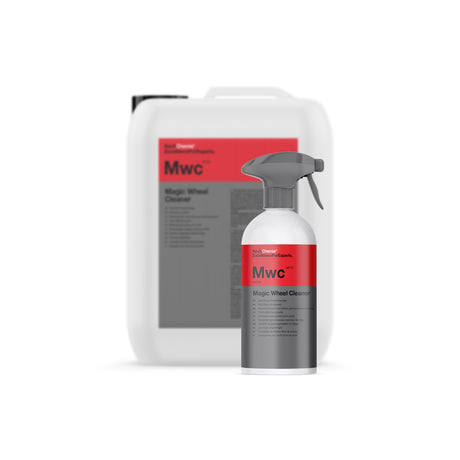
Ceramic coatings, wax sealants, and polymer protective layers are pH-sensitive. A cleaner like the Koch-Chemie Magic Wheel Cleaner (Mwc) works pH-neutrally and therefore leaves protective layers intact — even with weekly application. If you clean the same rim with an alkaline concentrate, you won't remove the coating in a single wash, but over several months, the applications add up. After two seasons of aggressive chemicals, a coating that was originally designed to last four years will have significantly weakened.
The most common question in customer support is therefore: Can I use my active cleaner on coated rims? Answer: With a modern, acid-free cleaner like the Koch-Chemie Reactive Wheel Cleaner yes — but not as a weekly routine. The cleaner is intended for decontamination, not for everyday use. One to two applications per season are sufficient; the rest is done pH-neutrally. This division of labor — an everyday cleaner plus an active cleaner for special applications — is the standard in professional detailing.

Coating, powder coat, polished aluminum — what kind of rim tolerates what
The surface of the rim determines which cleaner is suitable. Painted light alloy rims are the standard and tolerate pH-neutral and modern reactive cleaners without problems. High-gloss polished rims and diamond-cut finishes are delicate — only a pH-neutral cleaner should be used there, any deviating chemistry attacks the sensitive surface profile. Diamond-cut rims only have a wafer-thin clear coat layer over the milled aluminum; once washed through, corrosion starts.
Steel rims are the most robust type and can be treated with alkaline diluted cleaner. Chrome rims do not tolerate strong alkalis — here, pH-neutral is a must, otherwise chrome layers can become cloudy and stained. Powder-coated rims, as found on many aftermarket wheels, tolerate reactive cleaners but react sensitively to prolonged alkaline exposure. Anyone who has bought an aftermarket rim for 800 euros per piece is better off sticking to pH-neutral care.
The golden rule: the more sensitive the surface, the closer the pH value must be to seven. If you are unsure which rim is installed, stick to a pH-neutral cleaner and increase the dwell time. Better to wait two minutes longer than risk a flank of the clear coat. The test spot — apply cleaner to an inconspicuous area, let it dwell, rinse, check the surface — takes five minutes and, in case of doubt, saves a rim repair.
The workflow: cold, dwell, rinse — in that order
Rim cleaners only work reliably on cooled rims. Hot rims and cleaner are a recipe for cloudy stains, because the product evaporates in seconds instead of reacting. After a long drive, wait at least 30 minutes, longer in summer heat. The rim should be able to be touched without pain. A pragmatic rule of thumb: you should be able to place your palm on it and count to three.
The workflow is identical for all three types. Roughly pre-rinse the rim with water to remove sand and loose dirt — this prevents coarse dirt from leaving scratches in the clear coat when brushing. Spray the cleaner evenly over the entire rim, including the rim bed, where most of the brake dust is located. Observe the dwell time: two to five minutes for Mwc, one to three minutes for Reactive Wheel Cleaner, diluted according to instructions for alkaline concentrate.
During the dwell time, work through the spokes and the rim bed with a soft rim brush. Not too much pressure, the brush does the work, not your arm. Then rinse thoroughly with high pressure until the water runs clear. A common mistake: letting the cleaner dry. This happens on rims in the sun or with too long a dwell time — the dirt then rebinds to the surface and leaves streaks that a second cleaning pass has to remove.
Second common mistake: spraying cleaner on the rim and brushing immediately. Chemistry needs time to work. If you go directly with mechanical force, you replace chemical action with arm strength — this harms the spokes more than it helps.
A detail that makes the difference: separate utensils for rims and paint. The rim brush never goes on the paint, the rim microfiber cloth never on the hood. Particles that are picked up when brushing rims — iron-containing brake dust flakes, grit, sand — immediately cause swirls on painted surfaces. Colored cloth systems help to keep track: one color for paint, one for rims, one for the interior.

Five rim cleaners from our shelf — what makes each one special
From the Detailing1 range, there are five cleaners that cleanly cover the three type categories. The Koch-Chemie Magic Wheel Cleaner (Mwc) is our bestseller in the pH-neutral class: viscous, adheres to the rim instead of running off, reacts with iron particles through a visible red discoloration, suitable for weekly washing even on coated rims. Viscosity is the hidden quality factor — thin cleaners flow off the rim flange in seconds, viscous formulations stay on top and work where the brake dust is located.
The Koch-Chemie Reactive Wheel Cleaner is the reactive variant for decontamination use. Dwell time one to three minutes, up to ten minutes for heavy soiling. The violet color change shows when the cleaner has worked and when it needs to be rinsed off. One application in spring plus an intermediate cleaning in summer is usually sufficient. Anyone who wants to give their rims a brake dust restart without having to resort to harsh aluminum cleaners will find the modern, coating-compatible answer here.
The Koch-Chemie Alkali Wheel Cleaner (Awh) is the professional tool. The concentrate is diluted between 1:2 and 1:10 — for detailers, 1:5 is the standard mix for average contamination. Not intended for private weekly routines, but unbeatable when a set has not been moved for a long time or serves as a pre-wash before detailing. Anyone who owns a classic car or a seasonally stored second vehicle needs exactly this cleaner once or twice a year.
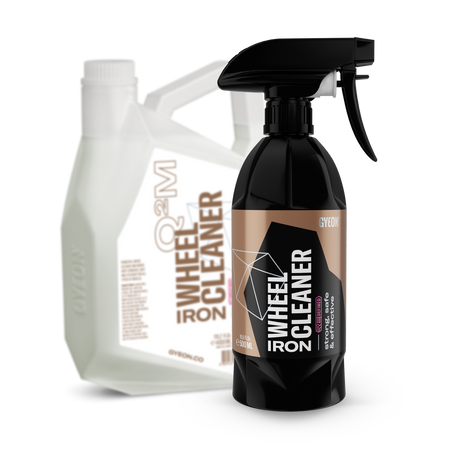
The GYEON Q²M Iron WheelCleaner REDEFINED is the coating-safe alternative in the reactive segment. pH-neutral gel formulation, banana as a fragrance substitute for the pungent sulfur smell of older iron removers, dwell time one to two minutes. For GYEON customers, it's the logical choice because the entire system logic is designed to be coating-friendly — and the smell makes use in closed driveways more tolerable.
The Soft99 Digloss Kamitore Wheel and Tire Cleaner is the special case: 2-in-1 for wheels and tires. 30 seconds dwell time, forms a protective film against re-soiling. Anyone who wants to clean tires and rims together and doesn't want two products in the bucket saves a step with the Kamitore. The formulation is pragmatically designed — not the strongest product on the shelf, but the most efficient for a Sunday wash.

Which cleaner for your problem
Three clear recommendations. If you wash off brake dust every week and want to protect a coating, the Mwc is the standard choice. pH-neutral, visible reaction, easy to dose, available in 500ml or 10L. With weekly use, one bottle lasts three to six months, depending on the vehicle fleet.
If your car has been stored or you want to remove rust film from the rim bed after winter, reach for the Reactive Wheel Cleaner. One application is usually enough to reset the rim — then maintenance continues with a pH-neutral cleaner. The active cleaner ritual once in April, once in July, once in October is sufficient for most everyday vehicles.
If you have a second car, a classic car, or a workshop set with weeks of dirt, the Awh is the right answer — diluted according to instructions, applied with a brush. For a combined wheel and tire cleaning on Sunday, when time is short, Soft99's Kamitore is the pragmatic tool. For owners of a full GYEON coating setup, the Q²M Iron WheelCleaner REDEFINED is the system-consistent variant.
And if you're still unsure: starting with a pH-neutral cleaner is never wrong. You can't make mistakes, you don't attack any coating, there's no minimum amount of dirt that's worth it. Try it out — and check out our workflow guide "Cleaning rims after winter" if you want the entire process step by step. You can find the complete selection of rim cleaners in the shop.
No time for the whole post? Get it summarized:
Add Detailing1 as a preferred source on Google