



Water Spots on Paint — Why a Quick Detailer Can Do More Than Just Shine
You carefully wash your car, dry it with a soft microfiber towel — and yet, the next morning, white streaks appear on the paint. Especially in April, when raindrops dry during short sunny periods and pollen adds to the problem, it becomes more apparent than in any other season: water spots. Minerals from the water — primarily calcium carbonate and magnesium carbonate — crystallize on the surface and cannot be removed with a normal quick detailer. You rub, you spray, you buff, but the white streaks remain.
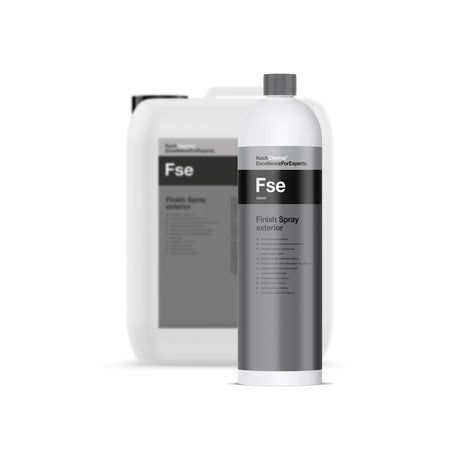
The Koch-Chemie Finish Spray Exterior "Fse" is a quick detailer with an integrated water spot remover. It removes water spots and water stains in a single step, restores deep gloss, and leaves behind a dirt-repellent layer — without the need for polishing, sanding, or post-treatment. In this article, you'll learn what distinguishes FSE from pH-neutral quick detailers, how to use it correctly, where its limitations lie, and when you should deliberately choose another product from the Koch-Chemie range.
What Finish Spray Exterior actually is
The Finish Spray Exterior is an acidic quick detailer — that sounds technical, but it makes all the difference. Its pH value is below 7. Most quick detailers on the market are formulated to be pH-neutral because they are supposed to work on any surface without causing damage. The FSE takes a different approach: the acidic component reacts chemically with mineral deposits and dissolves them. Calcium carbonate, magnesium carbonate, gypsum — everything that remains on your paint after hard tap water evaporates is attacked and dissolved by the formula.
A quick detailer is essentially a spray applied to already clean paint to enhance gloss, remove light dust layers, and leave a thin protective layer. The FSE can do all of this — and additionally dissolves mineral deposits that a pH-neutral product cannot chemically attack. It contains SiO2 components that leave a smooth, water-beading surface after wiping. The SiO2 fills microscopic imperfections in the clear coat, creating more uniform light reflection.
Koch-Chemie developed the FSE for professional use in detailing shops. There, it sits on the stainless steel trolley next to the drying towel, because it solves the most common problem after hand washing in one step: water spots that appear during drying. In Germany, water hardness in many regions exceeds 14 °dH — above this value, every drop that evaporates on the paint leaves visible mineral residues. The FSE was formulated precisely for this problem.
Spray, distribute, wipe — the complete workflow
Application takes less than three minutes per panel and requires no specialized knowledge. You work on clean, cool paint — that's the only prerequisite. The surface should not be warmer than lukewarm. Never apply to hot hoods or roofs that have been in the sun, as the acidic component will evaporate too quickly and leave concentrated residues instead of dissolving the water spots.
Spray the Koch-Chemie Finish Spray Exterior evenly onto an area of approximately 60 x 60 cm. Two to three sprays are sufficient for a panel of this size — the FSE is economical, and you don't need a thick layer. Distribute the product with a clean microfiber towel in straight, overlapping passes — not in circular motions, to avoid creating streaks. Then flip the towel to the dry side and buff the area in the same direction. You'll immediately feel the paint becoming smoother under the towel.
For more stubborn water spots that have been on the paint for several days, allow the product 20 to 30 seconds to dwell before wiping. The acidic component needs contact time to break down the mineral structure. The FSE works just as effectively on glass surfaces — spray, distribute, wipe. On glass, the descaling effect is particularly evident, as water spots instantly disappear from the transparent surface, and visibility becomes noticeably clearer.
The right towel is important: a microfiber towel with at least 350 GSM is a must. Thin polishing cloths with 200 or 250 GSM do not absorb the dissolved lime-water mixture cleanly and instead smudge it across the surface. Professionals work with two towels: one for spreading and working in, a second, dry one for final buffing. This two-towel workflow takes ten seconds longer per panel, but the result is streak-free.

Dissolve lime, add shine, protect surface — three effects in one step
The FSE solves three problems simultaneously, and this combination is its strongest point compared to specialized individual products. First: water spots and water marks disappear. The acidic formula reacts with the mineral deposits and chemically dissolves them. This is more efficient than mechanical polishing with an abrasive paste, as you don't stress the clear coat or sacrifice layer thickness. Burned-in water spots that have been on the paint for days dissolve after a short dwell time with no effort.
Second: The paint immediately gains visibly more depth and reflection. The SiO2 components in the FSE fill microscopic scratches and imperfections in the clear coat and reflect light more evenly. The result is not an artificial, oily wet look, but a clean, clear surface with true color depth. In independent tests, the FSE achieves 8.3 out of 10 points in the overall rating — and 100 percent of testers would buy it again. Especially on dark paints — black, dark blue, anthracite — the before-and-after difference is visible to the naked eye.
Third: The treated surface repels water and attracts less dust. The so-called lotus effect doesn't last for weeks like a ceramic coating, but it reliably bridges the time until the next wash. Dust and light pollen land on the smooth surface and are partially washed away by the next rain shower, instead of settling into the pores of the clear coat.
What makes the FSE additionally versatile: It functions as a lubricant for detailing clay. If you perform decontamination in the spring — removing flash rust, industrial dust, baked-on brake dust — you can use the FSE as a lubricant for the clay and save yourself a separate clay spray. The clay glides smoothly, the FSE simultaneously dissolves existing water spots, and in the end, you have a decontaminated, water spot-free surface in one step.
Not on coatings. Not on hot paint. The honest limits.
The FSE has clear limitations that you need to know — and which Koch-Chemie itself clearly communicates on its YouTube channel. First and most important restriction: Do not use FSE on ceramic coatings. The acidic formula can chemically attack the ceramic layer and shorten its lifespan. If you drive a vehicle with a professional ceramic coating, reach for Koch-Chemie Quick & Shine "Qs" — it is pH-neutral, cares for the paint, and is 100 percent coating-safe.
Second restriction: Never spray on hot surfaces. If your car has been in the midday sun and the hood is over 40 °C warm, wait until the paint is lukewarm or cooler. On hot paint, the solvent evaporates too quickly, the acidic component concentrates on the surface and can leave stains itself — exactly the opposite of what you want to achieve. In spring and autumn, this is rarely a problem, but in summer between 12 and 4 p.m., you should pay attention to the surface temperature.
Third restriction: The FSE does not belong in the interior. It is exclusively formulated for exterior surfaces — paint, glass, exterior plastics. For dashboards, door panels, and leather interiors, there are specific products tailored to these materials and their sensitivities.
And finally, durability: The FSE is a maintenance product, not a replacement for a sealant. The protective layer lasts for a few days, not weeks or months. If you want permanent protection, combine the FSE with a true spray sealant — FSE after washing for water spots, spray sealant for long-term protection. This combination is standard in detailing shops because each product does what it does best.

FSE, Quick & Shine or Quick Finish — when to use which Quick Detailer
Koch-Chemie offers three quick detailers in its range, and each has its clearly defined role. You now know the FSE — it removes water spots and adds shine to uncoated paint. The Quick & Shine "Qs" is its counterpart: pH-neutral, coating-safe, for routine maintenance between washes. The Quick Finish "Qf" is the specialist after a polish — it removes polishing residues and leaves a flawless surface for subsequent sealing.
The decision between the three is basically simple: Do you have water spots or water stains on uncoated paint? FSE. Do you drive a coated vehicle and want to refresh the shine between washes? Quick & Shine. Have you just polished and need a clean, residue-free finish before sealing? Quick Finish.
A common application error we observe in customers: using the FSE as a routine quick detailer for weekly maintenance. The acidic formula is intended for targeted use — when there are water spots that you need to dissolve. For regular interim care, Quick & Shine is the better choice, as it does not chemically stress the clear coat, leaves existing wax layers and sealants intact, and still delivers a clean shine.
Price-wise, the FSE is 10.55 Euros per liter in the spray bottle — compared to specialized descalers from car care retailers, which often cost 15 to 25 Euros per liter and do not offer any care or shine effect, this is a strong price-performance ratio. Professionals and detailing shops opt for the 10-liter canister and refill empty spray bottles — the price per liter then drops to under 10 Euros, and the canister lasts several months in daily operation.
For whom the FSE is the right choice — and for whom not
The FSE is the right product for you if you regularly struggle with water spots — and in Germany, this affects the majority of car owners. In over 60 percent of German water supply areas, water hardness exceeds 14 °dH, which is classified as "hard." Every drop of tap water that evaporates on your paint at these values leaves visible mineral residues. Anyone who doesn't rinse with demineralized water or operate a reverse osmosis system will appreciate the FSE as a permanent component of their wash setup.
Drivers of dark vehicles particularly benefit. Black, dark blue, anthracite, dark green — on these colors, water marks are immediately visible, even a few hours after washing. Those who drive a white or silver car see the spots less, but they are still on the surface. And on glass surfaces, they are always visible regardless of color — especially on the windshield in low sun.
For getting started, the 1-liter spray bottle is sufficient. With typical use — after every second to third wash, one pass over all paint surfaces and windows — it lasts several months. If you notice that the FSE becomes a permanent part of your wash workflow, it's worth switching to the 10-liter canister.
If you have protected your vehicle with a ceramic coating, the FSE is explicitly not for you. In that case, you need a pH-neutral quick detailer that cares for the ceramic layer instead of chemically stressing it. But for everyone else — whether garage washers with hard tap water, self-service car wash users, or professional detailing operations — the FSE fills a gap that most quick detailers leave open: chemically dissolving water spots instead of mechanically covering them.
If you want to know how to completely recondition your paint after winter, read our Spring Wash Guide — the FSE is the perfect finish for the last step in the spring workflow. And if you're wondering which spray sealant then takes over long-term protection, you'll find the answer in our Spray Sealant Category Guide.

No time for the whole post? Get it summarized:
Add Detailing1 as a preferred source on Google