



A greasy Alcantara steering wheel is usually just clogged
You grab the wheel, and at nine and three it no longer feels velvety. It feels smooth and a little tacky. In raking light, the exact spots where your hands sit are shining. Plenty of people assume the material is worn out and only a retrim will fix it. Most of the time that's not true. If you want to clean an Alcantara steering wheel, though, your very first attempt decides it, because the wrong product turns a clogged wheel into a worn one.
In most cases a greasy Alcantara steering wheel isn't worn, it's clogged with skin oil. A pH-neutral cleaner, worked in as foam on the brush, breaks down the grease, a damp cloth lifts it off, and once everything is dry you brush the fibres back up.
Skin oil glues the fibres together in the grip areas
A greasy Alcantara steering wheel happens when skin oil, sweat and hand cream glue the fine microfibres in the grip areas together and press them flat, until they reflect light instead of scattering it.
Alcantara isn't leather. It's a microfibre composite of polyester and polyurethane, roughly 68 percent polyester and 32 percent polyurethane according to trade sources. The surface is made up of countless fine fibres standing upright. They're what gives a sports wheel the grip you love: your hand doesn't slip, even when it gets warm. For you, that means the feel depends on those fibres standing up. Once they're lying flat, an expensive material feels like worn-out smooth leather.
Polyester happily picks up grease, but it doesn't soak it in the way an animal hide does. Whatever comes off your hands stays sitting between the fibres and binds dust and skin flakes there. Every time you turn the wheel, the heel of your hand pushes the clogged fibres further in one direction.
You see the result first at nine and three, later up at twelve o'clock too, where you shuffle your grip when manoeuvring. The zone down at six o'clock often stays almost like new. That's your tell: the difference between top and bottom isn't age, it's grease.
The good news is in the mechanism. As long as the fibres are only clogged, you can free them and stand them back up. It's a different story once they're worn away, say by a ring, rough gloves or a magic eraser. Then material is missing, and no cleaner brings it back. That's why it pays to clean early: a wheel that only shines in patches is usually still a cleaning job. One that looks like smooth leather all the way round often isn't any more.
Right now, in autumn, it speeds up. Dry heater air cracks your skin, so lots of people put hand cream on more often. Drive off straight after and you're massaging a greasy film into the steering wheel rim. Winter gloves add friction on top, quite a lot depending on the material. No wonder searches for Alcantara steering wheels peak in December, according to Google Trends. Clean it beforehand and you start the season when the wheel takes the most punishment with clean fibres.
Race-Tex isn't Alcantara and still gets the same care
Race-Tex is Porsche's own name for a microfibre with a suede feel, used among other things on the steering wheel rim of the GT models. The Alcantara brand, on the other hand, belongs to an Italian manufacturer.
The mix-up is understandable. Porsche has gradually replaced Alcantara with Race-Tex in newer model lines, and in everyday talk almost everyone still says Alcantara. Porsche's documentation for the 911 GTS says the steering wheel rim, seat centre panels, door handles and armrests are trimmed in the microfibre material Race-Tex. Mercedes-AMG and Audi use Dinamica on many models, another microfibre from Italy. BMW M simply calls its wheel the M Alcantara steering wheel. For you, sitting behind the wheel, the name changes very little.
All three materials work on the same principle: fine polyester fibres in a polyurethane binder. So they react the same way to grease, moisture and pressure. A mild, pH-neutral cleaner, very little water and a soft brush suit all of them. Solvents, leather grease and steam damage all of them. In practice, you don't need one care product for Porsche, another for BMW and a third for AMG.
One thing you should still take seriously: the owner's manual. In its own newsroom, Porsche shows a master detailer cleaning an Alcantara steering wheel and warns explicitly not to soak the wheel, because otherwise the material goes hard as it dries. In its care instructions, BMW describes a cleaner that you spray on directly. We'd rather put it on the brush as foam, for the reasons in the next section.
If your manufacturer specifies something, that comes first for your car. Our method stays within those guidelines, because it works with little moisture and no pressure.
And since everyone's talking about the new Audi RS 6 Avant (C8) today: if you're sitting in a family estate with supercar brakes, the next care question is waiting outside. Carbon-ceramic brake discs don't take kindly to stiff brushes or knocks from tools, so use soft brushes for wheel cleaning and keep anything greasy off the friction surface. How to get the rest of the wheel clean is in our post on cleaning rims after winter. Inside, nothing changes: its steering wheel appreciates the same gentle treatment as a 911's.

The cleaner goes on the brush as foam and never on the wheel
To clean an Alcantara steering wheel, you mainly need one move: the cleaner goes on a soft brush as foam, so the buttons, airbag area and heated steering wheel stay dry and the fibres don't get soaked.
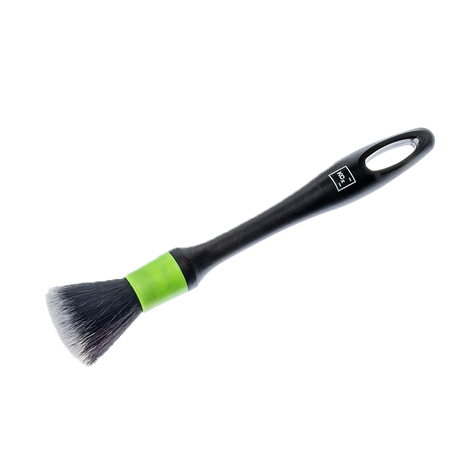
Before any chemicals come into play, you dry-brush the rim. With the Koch-Chemie Interior Brush "Green", go once all the way round in long, light strokes, always in the same direction. That loosens dust and crumbs that would otherwise act like sandpaper once things get wet. Lay a dry cloth over the instrument cluster behind the rim. That way nothing lands on the display if a drop does fall.
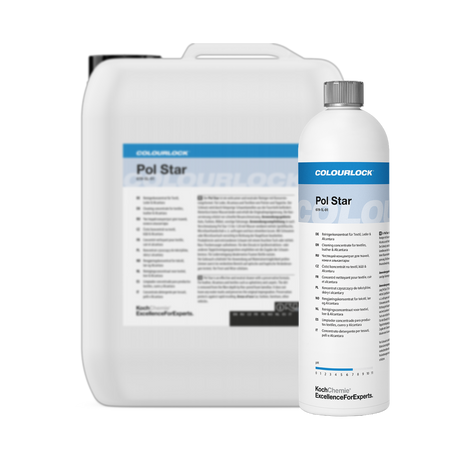
Then you mix up. COLOURLOCK "Pol Star" is a pH-neutral concentrate for fabric, Alcantara and smooth leather. For Alcantara, it's 1:10. Fill the Koch-Chemie Foamer Bottle with distilled water up to the 1:10 mark first, then add the concentrate, so about 14 millilitres to just under 140 millilitres of water. Distilled, because tap water can leave pale limescale marks on dark fibres. Tip the bottle two or three times instead of shaking it.
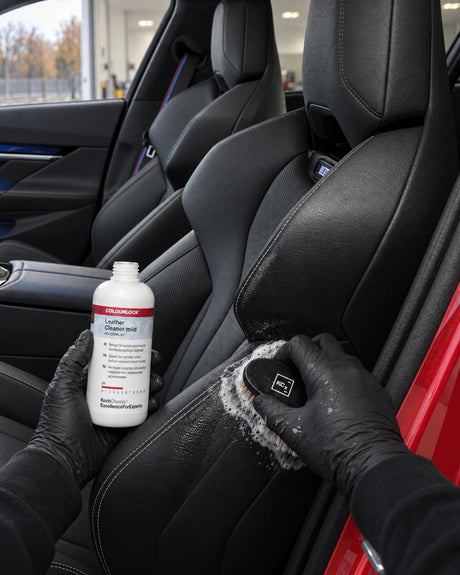
One or two pumps of foam go straight onto the bristles, not onto the wheel. Foam gets the surfactants to the surface without carrying much water into the cover. Sprayed on as a liquid, the solution would get pulled by capillary action into the foam padding under the cover, and it takes hours to dry out there. For you, that means the foam does the work the water isn't supposed to do.
Work in sections about a hand's width long. Set the brush down without pressure and run it along the rim in short strokes. After 30 to 60 seconds the cleaner has broken down the grease; according to the Pol Star usage notes, leaving it longer gains you nothing.
What matters is treating the whole grip area evenly, not just the darkest spot. Otherwise you'll see an edge between the cleaned and uncleaned zones. If you want it quicker, grab the ready-to-use SONAX XTREME Upholstery+Alcantara Cleaner (Propellant-Free), which also comes out of the pump bottle as foam.
Dry fibres brush up, wet ones stick together again
Once the grease is loosened, a slightly damp, wrung-out microfibre cloth lifts off the foam and grease, and after that the wheel has to dry completely before you stand the fibres up with a soft brush.
For wiping off, one grip has proven itself, and the Porsche detailer shows it too: wrap the cloth round the rim like a cuff, close your hand loosely around it and twist the cloth gently on itself, without scrubbing across the material. We use the THE COLLECTION "Allround / Coating 300" for this, because it's short-pile and edgeless and doesn't snag anywhere. Flip to a fresh side after each section as soon as the cloth turns grey.
On the first pass you often see just how much is sitting in the rim. The cloth turns brownish grey, and the treated section looks lighter and more matte than the rest. On a really greasy wheel, one pass is rarely enough. Plan two to three short rounds instead of one heavy session. A single wet pass tends to spread the grease around rather than lift it. That patience is the difference between a result that lasts and one that's shining again two weeks later.
Then comes the step most people skip: waiting. At normal room temperature, a foam-cleaned wheel needs about one to two hours to dry right through. During that time the fibres often look streaky and darker. That's normal and part of the process. Don't drive in the meantime, because warm, damp hands flatten the fibres again straight away. A hairdryer or a heater vent cuts the wait, but it makes the synthetic fibres go hard.
Once everything is dry, lightly brush the fibres up with the dry brush, again in one direction and without pressure. This is where the velvety grip comes back. In raking light you can tell whether the fibres are standing evenly. If a spot is still shining, repeat the pass there the next day. If it's still shining after that, the fibres there are probably worn away, and that shows you the limit of what cleaning can do.

Leather conditioner, steam and magic erasers leave the wheel permanently smooth
The three most common mistakes on an Alcantara steering wheel are leather conditioner, which glues the fibres together for good, steam cleaners, whose heat deforms the synthetic fibres, and magic erasers, which sand them off.
Leather conditioner is well meant. It contains oils and waxes designed to soak into an animal hide. Alcantara has no pores to take them in. The film sits on top, glues the fibres together and attracts fresh dirt. The wheel goes greasy faster than before. Almost everyone makes this mistake once, because Alcantara looks like suede. If you've already applied leather conditioner, the same method as above helps, just with more passes. Silicone-based dashboard sprays do exactly the same thing, by the way.
Steam cleaners are popular for interiors, but they're the wrong call for microfibre. Polyester and polyurethane are thermoplastic, they soften under heat. Alcantara, the manufacturer, itself advises against using steam devices and rubbing too hard. Too much water has a similar effect: Porsche warns that a soaked wheel goes hard as it dries. Then there's the tech inside the rim. The heated steering wheel, the sensors for hands-on detection and the buttons sit right under or next to the cover.
The melamine-foam magic eraser is the most dangerous tip, because at first it works. The shine disappears instantly and the wheel looks lighter. What's actually happening is the foam sanding off the top layer of fibres like very fine sandpaper. After one or two goes the material is thin and stays smooth, whatever you do afterwards. The same goes for stiff plastic brushes from a footwell set or the horsehair leather brush customers often ask us about. For Alcantara, the softest brush is the right one.
Home remedies turn up in every forum too: shaving foam, glass cleaner, washing-up liquid. Shaving foam contains re-greasing additives, glass cleaner often alcohol, and washing-up liquid is hard to rinse out completely and leaves marks. None of them is made for microfibre. If you've got nothing to hand at all, a clean cloth that's barely damp is the less harmful stopgap. Do the proper clean once you've got the cleaner and brush.
Five products are enough for a grippy Alcantara steering wheel
For an Alcantara, Race-Tex or Dinamica steering wheel, a pH-neutral cleaner, a foam bottle, a soft brush and a short-pile microfibre cloth are all you need, and together they take up hardly any room in the glovebox.
The foundation is COLOURLOCK "Pol Star" in the 250 ml bottle. At 1:10 that makes about 2.75 litres of working solution, enough for the wheel, seat bolsters and centre armrest for many months. Pol Star also cleans upholstery and pigmented smooth leather; it isn't meant for nubuck or suede. Customers rate it 4.8 out of 5 stars on Trusted Shops. The catch: as a concentrate, you have to mix it, which costs you a few minutes the first time.
The Koch-Chemie Foamer Bottle turns the solution into the dry foam that makes all the difference. It has a printed scale up to 1:10, so you don't need a measuring cup. The catch: after the session you should pump it empty with clean water, otherwise the pump dries up. The Koch-Chemie Interior Brush "Green" is the softest interior brush in the Koch-Chemie set. For dried-in crumbs in seams it's almost too gentle, for the fibres on the rim it's spot on.
For wiping off, the THE COLLECTION "Allround / Coating 300" belongs in the kit, ideally two of them, one damp and one dry. If you'd rather not mix anything, the SONAX XTREME Upholstery+Alcantara Cleaner (Propellant-Free) is the ready-to-use alternative in the 500 ml pump bottle. It's designed more for larger upholstery areas and also neutralises odours. On the wheel, go easy with it, and again apply it to the brush. You'll find more cleaners from our range under textile cleaner.
How often? On a car you drive every day, you should clean an Alcantara steering wheel as soon as the grip areas start to shine, and every two to three months at the latest. In between, it helps to give the rim a quick dry brush after long drives. And if you've just put hand cream on, wait a few minutes before you drive off. For Alcantara seats and bolsters, your best bet is our post on cleaning Alcantara, and for a smooth leather wheel, the post on the leather steering wheel.

Detailing1-Insight: Before you decide whether a wheel can still be saved, compare the grip areas with the zone down at six o'clock. Hardly anyone touches it, so it shows you what your material looks like new. Clean just a hand's width at nine o'clock first with Pol Star at 1:10 and let it dry for two hours.
If it goes as matte as the bottom, the whole rim is worth doing. If it stays smooth even though the cloth comes away clean on the third pass, there's no grease left, the material is gone. At that point an auto trimmer is a better bet than any cleaner.
No time for the whole post? Get it summarized:
Add Detailing1 as a preferred source on Google