



Rings form as the seat dries, not while you clean it
You spray on the upholstery cleaner, scrub the stain away, and the seat looks soaking wet but clean. Two days later a brown ring shows up in exactly that spot, bigger than the stain ever was. That is why the question we hear non-stop at Detailing1 is not just which cleaner, but will my seat actually be residue-free clean afterwards.
Cleaning car seats without rings is three-quarters physics and only one-quarter chemistry. Control the amount of water, work with distilled water and pull the surfactants back out at the end, and you get clean upholstery with no rings.
Why wet seats turn up brown rings days later
Rings on upholstery are not a chemistry failure, they are a drying phenomenon. They only appear hours after cleaning, once the water evaporates and drags the dissolved dirt out to the drying edge.
Physics calls this the coffee ring effect. The outer edge of a damp patch grabs onto the fibres and stays put as it dries, while water keeps evaporating in the middle. To make up for the loss, a fine current flows from the centre outward, carrying every dissolved dirt particle and every bit of leftover surfactant to the edge. The water goes into the air, the dirt stays behind as a sharp line. That is the exact line you see two days later.
Nastier still is the wicking effect, sometimes called the capillary effect. A car seat is not a flat cloth, underneath sits a thick polyurethane foam core, plus the seat heater and the sensors of the occupancy detection. Soak the upholstery and the dirty water runs deep into that foam. As it slowly dries, the top fabric acts like a wick and pulls the dirty brew back up over several days. The result is a seat that looks spotless right after the job and ends up with dark, map-like stains once it has dried through.
On top of that, everyday life adds a second type of ring that has nothing to do with dirt. Hard tap water brings limescale with it, and that limescale crystallises out as a pale edge while it dries. Water hardness is measured in degrees of German hardness: soft sits at 0 to 7 °dH, medium at 7 to 14, hard above 14. Across much of Germany you are in the hard range, and then it is not the cleaner doing a bad job, your water is what leaves the marks.
Most people want to clean their car seats in summer, when sand, sunscreen and ice-cream stains pile up, and that is exactly when the ring risk is highest. The upholstery dries faster, sure, but the quick evaporation ramps up the capillary pull and drags more dirt to the surface rather than less. So if you want to clean upholstery in high summer, work in the shade, in the garage or a hall rather than in blazing sun, so the drying stays slow and even. Fast heat is no ally when you clean upholstery, it is the direct route to a ring.
Upholstery, Alcantara and leather need three different dilutions
The most common mistake is treating every seat surface the same. Fabric upholstery, Alcantara and leather react completely differently, and this is exactly where you either clean them or ruin them.
Almost daily the same question lands in our inbox on this point: is the cleaner safe for Alcantara. Alcantara is not suede, it is a synthetic microfibre velour, roughly 68 percent polyester and 32 percent polyurethane. Its velvety look comes from the upright pile, millions of tiny fibre tips. Work with pressure and in circles and those tips felt together into hard little nubs, the dreaded pilling, and that damage will not wipe off. So you clean Alcantara pH-neutral, at a gentle 1:10 to 1:20 dilution, and always softly along the grain, never in circles.
Classic fabric upholstery in nylon or polyester is tougher and takes a medium-soft brush. Its weak spot is how much it soaks up: surfactant rings love to gather here, and the foam core is easy to over-saturate. For normal grime you go 1:10, for stubborn dirt on carpet and floor mats you drop to 1:5. Pigmented smooth leather, on the other hand, is sealed on the surface and hydrophobic, water beads off. It takes a gentle clean at 1:20 but reacts to too much surfactant with a loss of sheen, so you deliberately keep it weak here. How deep you can go on the pile we have spelled out in detail in our piece cleaning Alcantara without ruining the pile.
One material group stays off-limits: open-pored natural leathers like aniline, nubuck and suede. They have no protective top coat, they are strongly hydrophilic and pull every drop of water straight into the depths. A water-based spray cleaner will inevitably leave dark migration rings here and stiffen the fibres. Seats like that belong with a saddler, not under the spray bottle.

Vacuum first, then mix with distilled water
The two most important steps against rings happen before the cleaner even touches the upholstery: vacuum thoroughly and mix with the right water.
Dry vacuuming is the step beginners almost always skip, and it is the most important one. When loose sand, dust or crumbs sit dry in the weave, you vacuum them out with no effort. Spray cleaning solution straight onto them instead and the dust turns into a sticky sludge on the spot, which the capillary forces pull deep into the foam core. Take your time on the seams and crevices, that is where the abrasive grit sits, the stuff that cuts the weave apart from the inside.
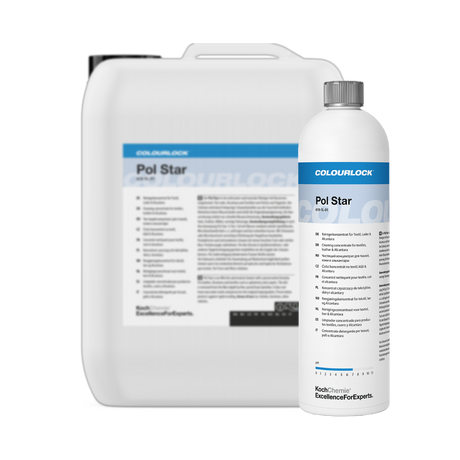
When you mix, the water is what decides it. Use distilled water, not tap water, or you will build the limescale rings from the first section straight into your own work, and they show up worst on dark Alcantara. The COLOURLOCK Pol Star is a pH-neutral concentrate with a pH value of exactly 7.0, meaning it attacks neither the polyurethane in Alcantara nor the top coat on leather. For a 500 ml spray bottle at 1:10 you mix about 45 ml of concentrate with 455 ml of distilled water. One litre gives you up to eleven litres of working solution that way, at 1:20 even up to 21 litres, which keeps the cost per job very low.
Pol Star works with amphoteric surfactants, 5 to 15 percent, plus a small share of anionic surfactants. Surfactants are molecules with two faces: a water-loving head and a fat-loving tail. The tail latches onto skin grease and dirt, the head keeps the whole thing in the water, the dirt floats free and lifts off. For you that means the chemistry loosens the dirt, you do not have to scrub raw. A mixed solution keeps for about seven days, after that the effect fades, so only mix what you need.
Spray on, let it dwell, and lift it back out along the grain
Now comes the part that decides between rings and clean. It is not the spraying that is critical, it is lifting the loosened surfactants back out at the end.
Lay the solution down over the whole area with a fine spray head, not just spot-on onto the stain. Spot-spraying creates a wet island with a dry edge around it, and that boundary is exactly where the coffee ring effect kicks in. Always work the whole seat segment, seam to seam. On absorbent fabric upholstery you can work the cleaner into a fine foam with a medium-soft brush, on Alcantara only gently and linearly, along the grain, with a soft cloth or applicator.
The dwell time is short. Pol Star hits its effect after 30 to 60 seconds, longer does nothing, because the surfactants have reached their plateau. In that time they wrap the dirt into tiny beads and lift it out of the fibre as fine-pored foam lamellae, you can literally watch the brew come to the surface.
The decisive step is lifting it out. Grab a short-pile microfibre cloth, misted damp with distilled water, and take off the foam and the dirt along the grain. Fold and turn the cloth after every pass, or you will just massage the dirt back in. Repeat until nothing foams any more, because if it still foams there are leftover surfactants in the weave. Those exact leftovers dry sticky, pull new dust out of the air like a magnet and make sure the seat is dirty again faster than before. For large fabric areas the pros use a spray extraction machine that sprays clean water in and vacuums it straight back out, but by hand with a cloth and a bit of patience it comes out just as ring-free.

Four mistakes that create upholstery rings in the first place
Rings, streaks and a clammy, sticky seat almost never have anything to do with the product. They come from four application mistakes, all of them avoidable.
The first mistake is the wrong cleaner. A lot of people reach for an alkaline all-purpose cleaner indoors, say an APC with a pH value around 12.5. On fabric the alkali destroys the factory impregnation, on Alcantara it hardens the polyurethane, on leather it pulls the plasticisers out and cracks the top coat over time. Indoors calls for a pH-neutral cleaner, not a wheel or engine-bay product. Which cleaner suits which surface we have sorted out in our interior cleaners.
The second mistake is drowning the seat on the more-is-more principle. Too much water floods the foam core, loosens ten years of dirt and pushes it back up through the wicking effect as it dries, worst case with mould in the core and a short in the seat sensors. The third mistake is destructive scrubbing: minutes of rubbing with a hard root brush tears the weave structure open, melts synthetic fibres and felts Alcantara on the spot. Let the surfactants do the work, not your muscles.
The fourth and most common mistake is spot-cleaning with no follow-up: spray on, wipe over quickly, let it dry. That is exactly where the surfactants stay in the weave, and exactly where the ring comes from. Spray on, let it dwell, lift it fully back out, that is the order. If you want to know more about the right sequence for the whole interior, it is in our post on the Pol Star routine.
Your setup for ring-free car seats
If you want to clean your car seats regularly, you do not need an expensive machine, you need four things: the right concentrate, distilled water, a spray bottle and a good microfibre cloth. These four cover upholstery, Alcantara and leather, from the everyday stain to the deep clean.
The heart of it is a pH-neutral concentrate that covers all three materials. The COLOURLOCK Pol Star cleans upholstery, Alcantara and pigmented smooth leather out of one bottle, dosed 1:5 to 1:20 depending on the material. Since Koch-Chemie took over the leather specialist COLOURLOCK, the proven Pol Star Po runs under the new label, the formula and the production in Unna are unchanged. The first reviews on Trusted Shops are positive across the board. One special feature helps you twice against rings: a built-in Conserver protects the existing impregnation and, once dry, lays down a thin protective layer of its own that slows fresh soiling.
Then come the tools. A fine spray bottle for even application, a short-pile cloth like the A1 Das Tuch for clean pickup, and on the water you stay strict with distilled. You will find the whole selection of matching products in the Textiles and Upholstery category.
One last point on protection. The Conserver in Pol Star maintains the impregnation, it does not replace it. If you want to build the water and stain protection fully back up after a deep clean, apply a dedicated textile impregnation like the Soft99 Cloth Barrier once it has dried through, and on leather you give the seat its suppleness back with a leather conditioner.

Detailing1 insight: By far the most common mistake we see is too strong a mix. Plenty of people start out of impatience at 1:10 instead of 1:20, or tip 1:5 straight into the bottle because more surely cleans better. That exact overdose leaves surfactant rings that only pop up as pale rings when it dries. On our test cars at the Showroom in Nordhorn we always mix 1:10 first, work the whole area seam to seam instead of just the stain, and only move to 1:5 when a carpet is still being stubborn after the first pass. Twice gently beats once too harsh, it saves you the ring and the second cleaning day.
No time for the whole post? Get it summarized: