



With a pressure washer the distance decides what your paint survives
There's one question that keeps landing in our inbox, and it sounds harmless: can I wash my car with a pressure washer? The answer is nearly always yes, and nearly always the second half is missing. Because it isn't the machine that decides whether your paint survives the wash. It's two numbers that appear on no spec sheet.
The impact pressure on your paint does not come from the pump pressure. It comes from the nozzle angle and the distance. Between five and thirty centimetres it drops by a factor of twenty-five. Know that, and you clean better with less force.
Why this Saturday is your washing window
Today reads 31 degrees here in Nordhorn with rain from the early evening. That's the worst day of the week for a wash outdoors. From Thursday the picture flips: the weekend brings a solid dry working window, and Saturday is the day most of us actually have time. Plan today instead of washing, and on Saturday everything is ready to go.
The reason for holding off is panel temperature. A dark car in full sun reaches surface temperatures above 70 degrees. Pre-wash chemistry sits almost always in the alkaline range between pH 8 and pH 12, because it has to break down organic soiling by saponification. Put that solution onto 70-degree metal and the water content flashes off in seconds, leaving highly concentrated alkaline salts behind.
What happens next is called chemical etching. The salts eat into the polyurethane network of the clear coat and leave milky, blotchy patches that no hand wash will pull back out. What follows is machine polishing, and in the worst case wet sanding. The same heat also breaks down the silicon dioxide bonds of a ceramic coating you spent half a spring day laying down.
So treat this as a preparation piece. If you want to wash your car with a pressure washer on Saturday, you have four days to sort out two things: which nozzle sits on your lance, and which distance belongs to which zone on the car. Both cost you ten minutes today and nothing at all on Saturday.
What the jet does to paint, film and seals
Run the numbers on a typical 120-bar machine pushing 480 litres an hour. A 25-degree fan jet delivers 0.75 megapascal onto the surface from five centimetres. From twenty centimetres it's 0.07, from thirty only 0.03. Same jet, same machine, same setting: only the distance changed, and the load has fallen to a twenty-fifth.
The nozzle angle pulls in the same direction, only faster. A 0-degree pencil jet still puts 0.87 megapascal on the panel from ten centimetres. A 40-degree nozzle from those same ten centimetres lands at 0.14. So if you let the distance slip once, a wide nozzle forgives you and a narrow one doesn't. That's why the nozzle choice at the car matters more than any pressure setting on the machine.
Intact clear coat takes a surprising amount, as long as the force arrives spread out. It gets dangerous at micro defects: stone chips on the front end and sills, hairline cracks, old rust blisters. Put a focused jet with more than 0.1 megapascal onto the open edge of a stone chip and the water works its way under the layers. Water doesn't compress, so it forces the layers apart and the paint flakes off in a patch.
This is where practice and expectation part ways. A pressure washer takes no healthy paint off. It exposes what was already damaged. German detailing forums show exactly this pattern: paint lifts where a blister or a crack already sat, and the wash gets blamed for damage that is months old.
With paint protection film and wraps the limit sits far lower. Thermoplastic polyurethane hangs on an acrylic adhesive, and that adhesive is sensitive to shear at the edges. Film makers set 80 bar as the ceiling, ask for a 40-degree wide fan at minimum and a distance of 30 to 50 centimetres. What matters most is the angle of attack: the jet meets the surface square on, never flat into a bonded edge.
The most expensive trouble sits in parts nobody watches. Wheel bearings are sealed with twin elastomer lips, built to shrug off spray at ambient pressure. A point-blank hit lifts that lip for a moment, water emulsifies with the bearing grease and the lubricating film collapses. What starts as a faint hum ends as a bearing failure. Parking sensors work with fine piezo membranes and answer pressure pulses from under 30 centimetres with a constant tone or a fault code.

Nozzle and distance for each zone on the car
Behind this sits fluid mechanics, not opinion. The exit velocity of the water grows with the square root of the pressure, while the impact force grows linearly with the volume of water. What that means for you: a machine with 130 bar and 600 litres an hour washes faster and gentler than one with 150 bar and 350 litres. More water means a thicker cushion between jet and paint. We worked that through yesterday in the buying guide on litres versus bar.
For day-to-day use there's a rule of thumb that has been going round the German detailing forums for years and lands surprisingly close: hold your own hand in the jet. If it turns unpleasant, you're too close to the paint. The distance at which the jet only pushes against your palm instead of stinging it sits, on most machines, almost exactly at the 30 centimetres the maths spits out.
Washing a car with a pressure washer means different numbers for every zone. For painted bodywork that's a 25 to 40-degree nozzle angle, 30 centimetres of distance and 130 bar at most. And the jet keeps moving the whole time. Park it on a stubborn spot and you do exactly what the maths forbids: you stack load onto one single point instead of spreading it over the panel.
Wheels and tyres take more. Here you work at 25 degrees from 20 to 30 centimetres and 110 to 130 bar. Two exceptions: stick-on balance weights and the tyre sidewall. Blasting the sidewall from close range can damage the carcass without anything showing on the outside. In the wheel arch you can drop to 20 centimetres to break off caked mud, but you keep the boots, gaiters and the hub consistently out of the line of fire.
The engine bay is the most sensitive area of all. That calls for 40 degrees, more than 50 centimetres and 60 to 80 bar, with the jet raining down rather than hitting. For parking sensors and cameras the same principle applies, only harder: 30 to 40 centimetres minimum, under 100 bar, never straight at them. One manufacturer writes 30 centimetres minimum distance and 82 bar maximum into the handbook for its camera systems.
And then the shut lines. Door gaps, headlight seams, window rubbers: that's where you can see the dirt sitting, and that's exactly where you want to aim. The pressure forces water through sealing lips built for rain. You end up with damp carpets, fogged headlights and, at worst, a soaked control unit. Run the jet flat across the gaps instead of into them.
Foam buys the pressure off you
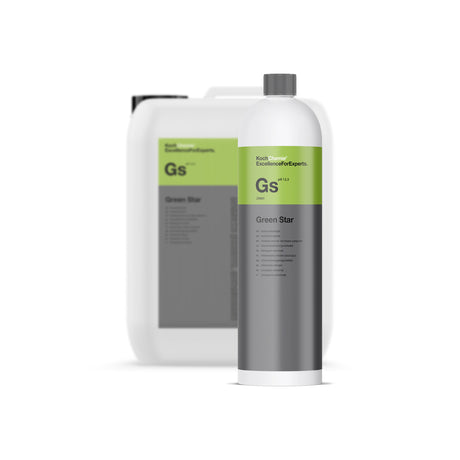
The real fix is an awkward one, because it looks like waiting: pre-wash chemically and you never need the critical pressure. Koch-Chemie Gentle Snow Foam „Gsf" 1000 ml / 1 Liter is formulated pH-neutral, which makes it the pick when a sealant or a wax is sitting on the paint. The foam softens the layer of grime before anything touches the metal. Customers rate it right at the top on Trusted Shops.
When the car is genuinely caked, Koch-Chemie Vorreiniger B „Vb" 1000 ml / 1 Liter is the stronger card. It's alkaline, so it breaks down oils, road film and insect remains by saponification. One buyer describes his routine for a quick wash between details like this: spray it on, let it sit briefly, rinse it off, and a big share of the dirt is gone straight away. That's exactly the effect you would otherwise have to buy with distance and pressure.
Both have a clear limit. Snow foam on its own will not lift baked-on insect protein after a motorway run, that takes an enzymatic bug remover and patience. And alkaline pre-cleaners never belong on hot metal or in the sun. Run Vorreiniger B above 30 degrees and you're better off diluting 1:20 instead of 1:10 and working in the shade only.
You don't strictly need a foam lance to lay it down. If your machine doesn't push enough flow for a decent lance, the iK Sprayers „iK Foam" Pro 2 Pumpschaumsprüher 1.25 Liter is the more pragmatic answer. It works independently of the pressure washer, you mix it yourself and you put the foam exactly where it's needed. Which lances and adapters fit which machine is in the pressure washer category, the matching concentrates under snow foam.

These mistakes cost paint, badges and bearings
The most expensive mistake has a name: the rotary nozzle. The dirt blaster makes a hard 0-degree pencil jet and throws it in a circle on an eccentric bearing. It was built for weathered concrete and moss-covered paving slabs, not for cars. On paint it acts like a spinning cutter and mills through to primer at pre-damaged spots within milliseconds. On tyre rubber and trim it simply cuts.
Mistake two is the reflex to move in closer when the dirt won't shift. From five centimetres with a 15-degree nozzle you're at 1.26 megapascal. That's the order of magnitude where badges fly off. Modern lettering and trim hang on double-sided acrylic foam tape, and the shear force of a focused jet slices that foam like a scalpel. The right answer isn't more force, it's more dwell time.
Mistake three catches everyone running a hot-water machine. Between 40 and 50 degrees the cleaning power climbs noticeably, because road grease melts. Above 60 degrees the benefit flips: plastic parts warp, film adhesive and badge tape soften, rubber seals age faster. If you're running a wrap, stay under 40 degrees to be safe.
Mistake four is the high-summer classic and the reason for this whole piece: putting chemistry on hot metal and then finding the foam has already dried before the hose was ready. The fifth weighs less but stings just as much: leaving the car in the sun after the rinse. The droplets don't act as burning glasses. As they evaporate they leave calcium and magnesium behind, and those minerals etch into the clear coat as water spots.
Above thirty degrees the order is what counts
The sequence that takes the heat out of the equation starts with plain water. Before any chemistry you cool the bodywork down: 40-degree nozzle, 40 to 50 centimetres, working from the roof down. The high flow pulls the panel temperature to a safe level within a few minutes. If you have the choice, you park the car in the shade for the whole job.
Only once the paint is hand-warm does the foam go on. It has a second job here that almost nobody knows about: the air bubbles work as a thermal insulator and slow the evaporation right down. The surfactants stay liquid longer and keep working on the dirt longer. In cool weather snow foam can sit for five to ten minutes. Above 30 degrees that window shrinks to one, at most three.
From there you stop watching the clock and watch the foam. The moment it turns thin, bubbly and see-through at edges like the roof rail or the bonnet lip, you rinse immediately. On the first rinse pass you work bottom to top so the foam keeps working up high, on the second top to bottom so gravity carries the loosened dirt away. The jet meets the surface at roughly 45 degrees, because that's where the shear force peaks.
After that it's about pace. Either you rinse down with deionised water or you dry by hand straight away. Anything else gives the minerals time to settle in. Keep to those four phases and you can wash your car with a pressure washer without ever going under 30 centimetres or over 130 bar. How the touchless pre-wash works in detail is in our piece on the snow foam pre-wash.

Detailing1 tip from the shop: When someone calls us with fresh paint damage after a pressure wash, I always ask the same thing: what was on that spot before? Almost every time there was already a stone chip or a blister sitting there. So before every wash I run my hand over the front end, the sills and the arch edges. Where I feel an open edge I stay 50 centimetres away and come back to that spot later with the wash mitt. Two minutes that have saved me a few very awkward conversations.
No time for the whole post? Get it summarized: