



The strong leather cleaner isn't the better one
Type “car leather cleaner” into Google in September and you usually have the same seat in mind: driver's side, bolster gone slightly greasy, a grey haze sitting in the grain that the microfibre won't lift. The reflex is to grab the strongest bottle on the shelf. That's exactly where the after-summer reset goes wrong, because the bottle ends up stronger than the dirt.
By the end of this you'll know why mild and strong are two different formulas, which dirt needs which level, how the foam gets onto the brush instead of into the seams, and which four cleaners plus one brush off our shelves cover the whole autumn reset.
A leather cleaner works on the topcoat, not in the leather
A car leather cleaner never touches skin, it cleans a wafer-thin plastic film, because nearly every factory leather is pigmented and carries a polyurethane topcoat that runs only 5 to 20 µm thick depending on the finish.
That film is why the leather in a new car looks so even and why a splash of coffee doesn't sink straight in. It's also why cleaning is allowed to stay this simple. The dirt sits on top of the finish, not down in the fibre. What you're looking at is body oil, sweat salt, sunscreen and fabric rub-off on a surface that has more in common with matt furniture lacquer than with a leather jacket.
That surface is slightly acidic, pH 4.5 to 5.5, much like human skin. A good leather cleaner stays close to that or sits neutral. Household all-purpose cleaners land at pH 9 to 12 and eat into the topcoat a little more with every pass. First it goes dull, then tacky, then it cracks.
The exception is aniline and semi-aniline leather with no covering pigment layer. It drinks liquid straight away, darkens in the drop test and only takes the mildest level with as little water as you can manage. If you have that leather in your car you usually know it, because it feels warmer and shows every touch.
So the first look isn't at the strength, it's at whether the product is built for finished automotive leather. Which leather you're actually sitting on, and whether it carries a topcoat at all, is sorted out in our post Identify your leather type. Everything from here on applies to pigmented smooth leather, so to about nine out of ten production cars.
Mild and strong are two formulas, not two dilutions
A strong leather cleaner isn't a mild one at double dose, it's a different formula with more surfactant, a share of mild solvent and often a slightly higher pH around 8, so dye and hardened grease let go.
The mild cleaner leans on gentle surfactants that emulsify body oil without stripping the topcoat. The COLOURLOCK "Leather Cleaner" (Mild) 1000 ml / 1 Liter from the Koch-Chemie × COLOURLOCK range is set to pH 5 to 5.5, the value of the leather itself, and comes out of the foamer as foam. Lederzentrum, the maker behind it, says it plainly in their own application video: mild and strong are two recipes, not two concentrations.
GYEON takes the same route with a different goal in mind. The GYEON Q²M LeatherCleaner Natural Lederreiniger (Mild) 500 ml is pH-neutral and deliberately skips oils and conditioners, so the leather stays factory-matt afterwards and will take a coating. The GYEON Q²M LeatherCleaner Strong Lederreiniger (Stark) 500 ml says pre-coating cleaner on the label: a higher surfactant and solvent load, meant for neglected leather ahead of a fresh coating, not for the monthly round.
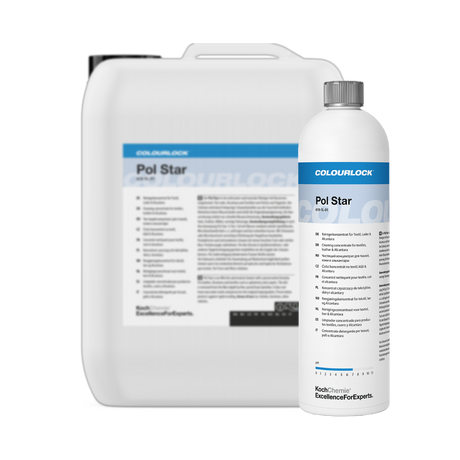
The third build is the concentrate. The COLOURLOCK "Pol Star" 1000 ml / 1 Liter sits at pH 7 and gets mixed 1:20 with water for leather, 1:10 for fabric and Alcantara. One litre gives you a good eleven litres of working solution. Mixed too strong it leaves white edges on smooth leather, and that's the most common mistake with concentrates.
On the label you spot the build from three things: pH value, dilution and intended use. A pH bar at 5 to 7 and no dilution given means a ready-mixed cleaner. A dilution given means a concentrate. If it says “pre-coating” or “strong”, that bottle belongs to the second level, not to your routine.

The dirt picks the cleaner, not the seat
Fresh body oil and sweat come off with mild, baked-in sunscreen wants a brush and patience, denim dye usually wants strong, and whatever is still there after that is a job for solvent or a re-dye.
Body oil is triglycerides and squalene, and under the sun it cures into that greasy shine every steering wheel shows after two summers. Mild surfactants emulsify it, a sponge is enough. Sweat salts crystallise in the grain and are water-soluble, so the light acidity of the mild cleaner takes them with it.
Sunscreen is the most stubborn thing summer leaves behind. The mineral filters titanium dioxide and zinc oxide sit as a white haze in the valleys of the grain, and the emulsifiers in the cream glue them to the topcoat. At 70 °C seat temperature in a summer car that bakes on hard. Fresh, mild plus a brush is enough, baked in, it takes the strong formula, whose solvent share breaks the bond.
Denim blue is indigo, a vat dye that only sits physically in the cotton and transfers onto light leather layer by layer with rubbing, heat and moisture. Inside the first 24 hours mild gets it off, after that you need strong. If you google “car leather cleaner” with cream leather and a blue driver's bolster, the strong bottle is the one. Whatever even that leaves behind is in the topcoat, and then no cleaner helps, only colour.
Two summer leftovers fall outside the pattern. Nicotine lies on everything as a yellow, sticky film and is water-soluble, so a mild cleaner and a damp cloth take it off. Hand cream and the silicones from care wipes are the other way round, they leave the leather slippery and shiny, and mild won't roll them off. Here the strong formula with its solvent share is the right call, even when the leather looks clean at first glance.
Before every level comes the test patch somewhere hidden, under the seat bolster or round the back of the headrest. If the white cloth takes on the colour of the leather, the topcoat is damaged, and then liquid is done, however mild it is.
Foam goes on the brush, never onto the seat
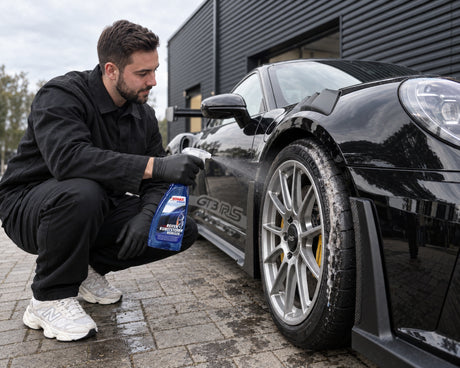
The cleaner never goes straight onto the leather, it goes onto the brush or pad as foam, gets worked seam to seam in small circles, comes off after 30 to 60 seconds with a barely damp cloth and then gets 20 to 30 minutes to flash off.
The reason for foam is water. The topcoat is sealed, the seams, the perforations in ventilated seats and every fold are not. Liquid cleaner runs in there, the collagen underneath soaks it up and pulls tight as it dries. Foam keeps the surfactant where the dirt is and brings almost no water with it. That's why you spray the GYEON into the brush, not onto the seat, and why the COLOURLOCK comes with a foamer.
Before the first foam lands, vacuum the seams and perforations out, otherwise the brush drags grit across the topcoat. Then you work in panels from seam to seam, one cushion, one bolster, one backrest, and you take each panel off before the next one starts. That keeps the dwell time the same everywhere, and the white cloth tells you straight away which panel is still giving up dirt.
The brush is the GYEON Q²M LeatherBrush Lederbürste 1 Stück, soft horsehair bristles in a wooden handle that carry the foam into the grain and lift the sunscreen out of the valleys. It needs no pressure, the bristles and the surfactant do the work. Hard household brushes and melamine sponges are off the table. A magic eraser acts like very fine sandpaper and takes the topcoat with it, the seat looks clean afterwards and is left unprotected.
How to pick bristle stiffness and how to guide the brush is in Using a leather brush properly. You take it off with a short-pile microfibre that is only barely damp, so it picks the loosened dirt up instead of smearing it around, then a dry cloth follows. The cleaner must never dry on, or the dirt binds again. About 100 ml of the GYEON does a whole car.
And then the pause. Give it 20 to 30 minutes to flash off at room temperature before any care or protection goes on the leather. The first seat takes longer than you'd think, that's part of it and it speeds up from the second one on. The weekend is staying dry by the current forecast, so the doors can stand open while the leather flashes off.

Four cleaners and one brush cover every level
For the autumn reset you don't need a cupboard full of bottles, you need one mild cleaner for the routine, one strong for the exception, one concentrate for fabric and Alcantara in between, and a soft brush.
The leather cleaner we sell most of is the COLOURLOCK "Leather Cleaner" (Mild). It suits any pigmented smooth leather, comes ready-mixed out of the bottle and is the one for the round every one to four weeks. If you clean the interior with the Q²M LeatherCleaner Natural instead, you notice the difference mostly in the finish. The GYEON leaves the leather without any shine at all, because there is nothing conditioning in it. That's the point, because protection comes next.
The Q²M LeatherCleaner Strong is the exception bottle. After a summer on light leather with denim dye and sunscreen it is the right second level, always with a test patch, always with the brush, always with protection afterwards, because it deliberately leaves the surface bare.
The COLOURLOCK "Pol Star" is our pick when leather isn't the only surface. An Alcantara steering wheel, cloth seats in the back, a headliner and leather in one car are all handled with one concentrate at two dilutions, 1:10 for fabric, 1:20 for leather. The Q²M LeatherBrush belongs with all four. You'll find the lot in our leather cleaners section, and the care for afterwards in leather care.
On quantity. At about 100 ml per car the 500 ml bottle of the GYEON gets you five full interiors, give or take, so the autumn reset and the winter routine on top. The litre of COLOURLOCK "Leather Cleaner" (Mild) is the size for anyone running two cars or going at it every other week. One litre of COLOURLOCK "Pol Star" makes eleven litres of working solution, more than a season of fabric and leather.
Body oil needs mild, denim dye needs strong, sunscreen needs patience
If the leather is just dull and a bit greasy, you take mild and a sponge. If there's a grey haze sitting in the grain, you take mild and the brush, strong on the second pass. If light leather has gone blue, you take strong and the brush.
If the car came back from the summer holiday with sunscreen on the door card and the seat, the order is mild plus brush, dry, check in daylight, and only then strong on what's left. If the steering wheel shines greasy, that's body oil, mild is enough, and the brush helps at the seams. If colour is still missing after two passes with strong, it isn't dirt any more, it's damage in the topcoat.
How often? The mild round every one to four weeks, depending on how much the car moves and whether kids, dogs or sunscreen ride along. The reset with the brush once after summer and once after winter, when road salt and winter jackets have left their marks. Strong only when the mild round visibly leaves something behind once it's dry, and protection after it every time, because the strong formula takes the last of the care with it.
So the answer to the “car leather cleaner, mild or strong” question runs like this. Mild as the standard, strong as a tool for one specific kind of dirt, never as an upgrade. Either way protection follows the cleaner, because clean leather loses moisture faster in heating season at under 30 % humidity in the car than leather still sitting under its own greasy film.
| Dirt | Cleaner level | Tool | Example off our shelves |
|---|---|---|---|
| Body oil, sweat, dull everyday film | mild | Sponge or pad | COLOURLOCK "Leather Cleaner" (Mild), Q²M LeatherCleaner Natural |
| Fresh sunscreen, grey haze in the grain | mild, strong on the second pass | Q²M LeatherBrush | COLOURLOCK "Leather Cleaner" (Mild), then Q²M LeatherCleaner Strong |
| Denim dye older than a day, baked-in sunscreen | strong | Q²M LeatherBrush | Q²M LeatherCleaner Strong |
| Leather, Alcantara and fabric in the same car | concentrate, 1:20 on leather | Brush and cloth | COLOURLOCK "Pol Star" |
Jasper's hands-on tip: The question I get most about leather cleaners isn't about strength, it's about dilution. A week ago someone had mixed the COLOURLOCK "Leather Cleaner" (Mild) like a concentrate and couldn't work out why the driver's bolster stayed dull. That cleaner is ready-mixed, the only one you dilute is the COLOURLOCK "Pol Star". And on leather protection I see a good 7 percent coming back, nearly always because it went onto uncleaned leather and turned patchy. Clean first, wait 30 minutes, then protect.

No time for the whole post? Get it summarized: