

Setting up a foam lance: nozzle, dosing and dwell time
Jasper von Detailing1 |


SONAX
PROFILINE Glass Detailer Concentrate Glass Cleaner Concentrate
Glass Detailer Concentrate — Ammonia-Free Glass Cleaner Concentrate
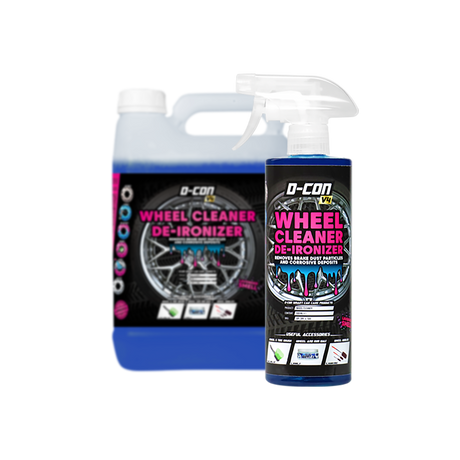
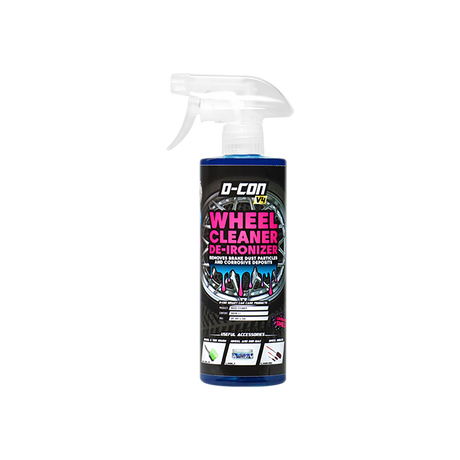
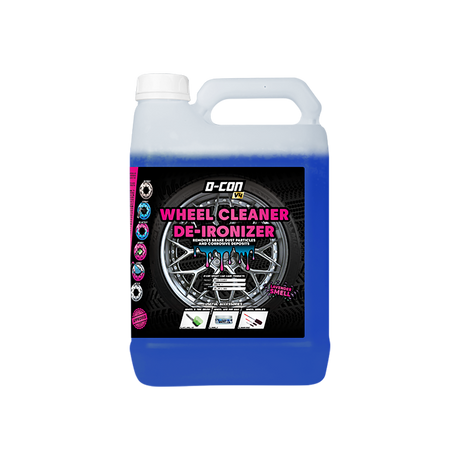
D-CON
"V4" Wheelcleaner & De-Ironizer Wheel Cleaner
Highly effective rim cleaner with lavender scent for all surfaces
The leather guide from our daily work.
Koch-Chemie
Silicone & Wax Remover "Sil" Degreaser
Efficient removal of silicone oils and waxes

SONAX
XTREME ScheibenKlar Glass Cleaner
ScheibenKlar — Streak-Free Glass Cleaner for Car Windows


Koch-Chemie
Hull Precleaner alkaline "Hal" Alkaline Pre-Cleaner (Marine Line)
Effective pre-cleaner for boat hull and boat deck

SONAX
PROFILINE MultiClean "Acid" Heavy-Duty Cleaner (Acidic)
MultiClean "Acid" — Acidic Power Cleaner (Concentrate)
What's a car cleaner? A product that lifts dirt off a surface chemically instead of scrubbing it away. The category pulls together pre-cleaners, wheel cleaners, glass cleaners, all-purpose cleaners, insect removers, iron removers and the solvents for tar and adhesive. Which one bites comes down to the type of dirt in front of you.
Car cleaners are products that dissolve dirt off a vehicle surface chemically rather than grinding it off mechanically. The umbrella term covers pre-cleaners, wheel cleaners, glass cleaners, all-purpose cleaners, insect removers, iron removers and the solvents that tackle tar and adhesive residue. What sets them apart isn't the brand, it's the point of attack. Every cleaner is built for one type of dirt and does next to nothing on the rest.
Detailing1's tip from the shop: What we see day-to-day, the priciest mistake in this category isn't the product you pick, it's patience. A cleaner needs dwell time, usually three to five minutes, for the actives to work their way under the dirt. Reach for the towel straightaway and you drag hard particles across the paint and pick up swirls — those fine circular scratches that show up like a spider's web in sunlight. And the other half of the same rule: never let the cleaner dry on. Work on a cool surface in the shade, spray panel by panel instead of the whole car, and rinse while the surface is still wet. Chemistry that dries in leaves edges that are harder to shift than the dirt was in the first place.
Every bit of dirt on a car fits one of four groups, and each group has its own point of attack.
Organic is anything that once lived: bug splatter, bird droppings, pollen, tree sap. Behind it sit proteins and fats that break apart in an alkaline environment. Alkaline means the cleaner sits above pH 7 and saponifies the fats — turns them water-soluble. In practice you notice it when a dried-on bug front runs off on its own after a couple of minutes of dwell time, instead of smearing into streaks under the sponge. The products for that live under insect removers.
Mineral is the opposite: limescale from hard tap water, water spots after drying in the sun, cement haze from the building site next door, road-salt residue in winter. These deposits are alkaline themselves, so an alkaline cleaner just bounces off. Here an acid does the work, converting the mineral into a water-soluble salt. Translated: that hard white spot becomes something that simply rinses away with the wash water.
Oily covers tar, bitumen, oil, silicone residue and adhesive left by badges or price stickers. Water and surfactants don't get far there, because the residue itself repels water. It takes a solvent that swells the stuff and lifts it. The Koch-Chemie Teerwäsche A „Tea" Bitumen- & Teerentferner belongs in this group, as does the Koch-Chemie Eulex „Eu" Klebstoffentferner for sticker residue and rubber transfer.
Metallic, finally, is fallout and brake dust. When you brake, glowing iron particles fly off the pad and burn into paint and wheels. An iron remover grabs those particles with an active from the thioglycolate family that wraps around each speck like a clamp and makes it water-soluble. Which means: what was burned in a second ago bleeds purple and runs off before you ever reach for a brush. That area has its own page under iron removers.
The rule of thumb behind it is simple. Chemistry beats chemistry; against the wrong chemistry only mechanics work — and mechanics on paint is always the pricier road. We often see customers buy the third product from the same group when the dirt actually belongs in another.
If you take one number away from this category, make it the pH value. It's rarely printed large on the label and it still decides between a result and damage.
Alkaline cleaners sit above pH 7 and are the workhorse for organic dirt and road film. They cover most of a normal wash, from the pre-cleaner through the all-purpose cleaner to the wheel foam. The higher the value, the more fat falls — and the more attention the sensitive surfaces next to it need.
Acidic cleaners sit below pH 7 and are the answer to mineral deposits and stubborn brake dust. They work fast but forgive little. On bright-polished aluminium, on magnesium wheels and on chrome, too long a dwell time can etch the surface dull, and that damage doesn't come back. So with acidic products the rule is: cold wheel, short dwell time, rinse thoroughly.
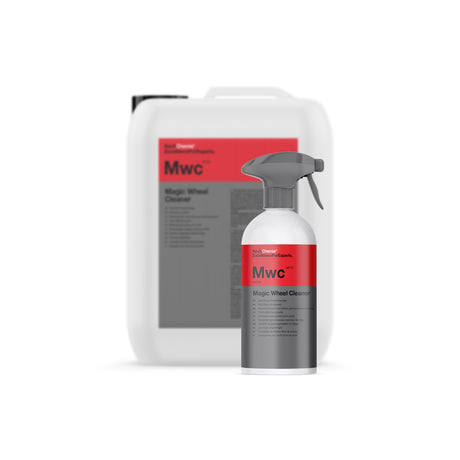
Neutral cleaners around pH 7 hit softer and are gentler in return. They're the right call on anything carrying a coating: fresh ceramic sealants, wraps, anti-glare displays. The Koch-Chemie Magic Wheel Cleaner „Mwc" Felgenreiniger shows the two can go together — acid-free by formula and still effective against baked-on brake dust, because it works through iron bonding rather than through pH.
The TUGA Chemie Alu-Teufel „Spezial"® (Grün) Felgenreiniger follows the same logic and is our best-selling wheel cleaner outside the Koch-Chemie line. The colour change makes the effect visible, and the acid-free formula takes away the worry about polished wheel lips.
One limit belongs stated plainly here: no pH value on earth replaces dwell time, and no cleaner works better because you mix it stronger than stated. Overdosed concentrates leave surfactant residue that pulls moisture out of the air and binds fresh dust within days. We often get enquiries about supposedly poor cleaners that turn out to be a dosing question.
The type of dirt tells you which chemistry you need. The substrate tells you which one you can afford.
Paint is the most delicate large surface on the car. The clear coat over it is only around 40 to 50 microns thick depending on the maker — about half a human hair. Anything that attacks or scratches it can only be corrected by removing material, and material is finite. So on paint we work with the mildest cleaners we can and rather give them more time. The products for chemical decontamination live under paint cleaning.
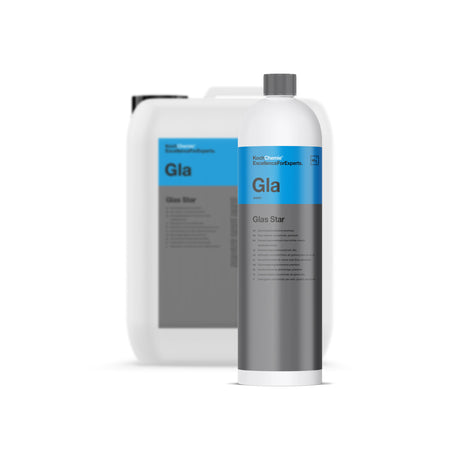
Glass takes a lot more and needs something else for it: no residue. A glass cleaner has to flash off fast and evenly, or you're left with streaks that show most with a low sun. The Koch-Chemie Glas Star „Gla" Glasreinigerkonzentrat is the concentrate version for anyone doing lots of glass, the Koch-Chemie Glass Cleaner „Gc" Glasreiniger the ready-to-use one for in between.
Wheels are the other extreme. There, heat, brake dust and road salt come together, and the surfaces are all over the place: powder-coated, painted, polished, chromed, matte. On painted OE wheels the product choice is uncritical; on polished and matte surfaces it turns critical straightaway. When in doubt, grab the acid-free iron remover and rather stretch the dwell time.
Exterior plastic and rubber — wheel-arch liners, trim, seals — take alkaline cleaners well and lose a little plasticiser on every pass. Without re-oiling afterwards, the door seal goes hard over the years. The protection step after that sits under care products.
For the surfaces that don't slot into any specialist group, there are the all-rounders. The Koch-Chemie Allround Surface Cleaner „Asc" Allzweckreiniger covers sills, floor mats, engine-bay covers and plastic add-on parts in one product. You'll find the whole group under all-purpose cleaners, the special cases under specialist cleaners.
Cleaners don't do their thing in isolation, but in an order. Turn it around and you work twice.
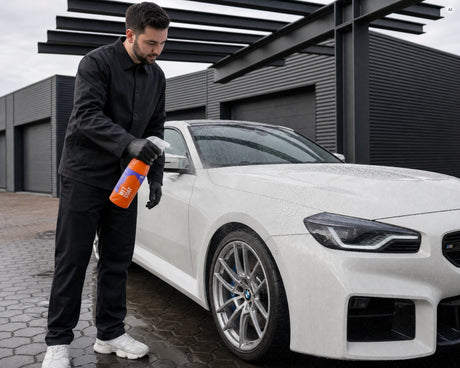
It kicks off at the wheels, and before the car wash at that. Wheel cleaner tends to spray, and whatever lands on already-washed paint you have to take off again. A second reason: the cleaner needs the wheel cold, and you've got that at the start of the round more than after twenty minutes in the sun.
Then comes the pre-cleaner on the dry, unwashed car. Its job isn't cleanliness, it's reduction: it lifts the coarse road film so your wash mitt drags fewer particles across the paint later. The Koch-Chemie Vorreiniger B „Vb" Vorreiniger is our best-selling item at this stage, the Koch-Chemie Pre-Foam efficient „Pfe" Vorreiniger & Insektenlöser the version that takes on bug splatter at the same time.
Only then comes the actual wash, with shampoo and two buckets. Everything you removed chemically beforehand can't set scratches now. The products for that live under car wash.
After the wash and before any protection step comes decontamination, and in this order: first the iron remover against fallout, then the solvent against tar, last the clay against the rest. The order isn't a ritual. Each step takes work off the next, and the clay lasts longer when it isn't dragged through tar spots.
Right at the end comes building up, not taking off. A freshly decontaminated surface is at its most receptive and at its most unprotected. Day-to-day at Detailing1 we regularly see cars where the cleaning was meticulous and the protection step never came — four weeks later the paint looks like it did before, and the work was consumables.
Our range in this category is broad, and the weighting says something about the market.
SONAX makes up by far the largest group and covers every price level, from the entry product to the PROFILINE line. Koch-Chemie follows as the second-biggest block and dominates the bestseller list in return. On top of that come GYEON, CarPro, Soft99, Meguiar's, D-CON and TUGA Chemie, each with smaller, clearly focused selections. The spread runs from the handy spray bottle to the jerrycan for the pro.
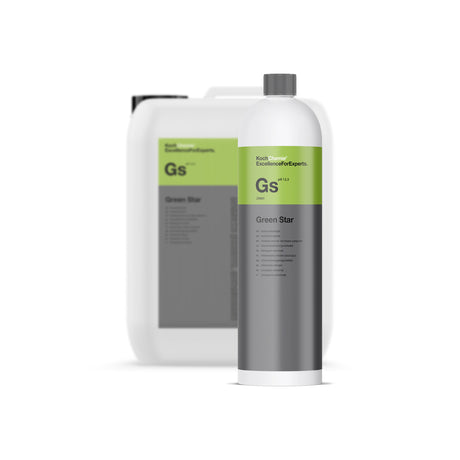
The revenue leader of the whole category is the Koch-Chemie Green Star „Gs" Universalreiniger, an alkaline concentrate that runs from a gentle interior cleaner to a punchy wheel and engine-bay cleaner depending on dilution. That very range explains its position: one jerrycan replaces three spray bottles, and you set the strength yourself.
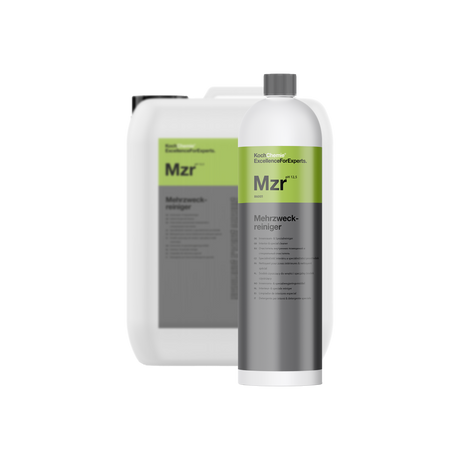
Right behind it sits the Mehrzweckreiniger „Mzr", set milder and so landing more often on the interior. Anyone who knows both uses the Green Star for outside and low down, the Mehrzweckreiniger for inside and up top.
The choice between concentrate and ready-to-use is a quantity question in the end. One car, two to four washes a year: spray bottle. Several cars in the household, monthly care or a used car being worked through once: concentrate. The price per litre is one thing, the flexibility in dosing the other and often the more important argument.
What this category deliberately doesn't cover is polishes and sealants. A cleaner takes away, it lays nothing on. The moment dirt is no longer chemically soluble but sits in the paint, this page's job ends and the polish's begins.
If you're just starting out, you don't need a collection. Three products cover the everyday.
First, an alkaline pre-cleaner. It's the step with the biggest effect on paint condition, because it removes the particles your wash mitt would otherwise carry. Second, an acid-free wheel cleaner with a colour change that doubles as an iron remover on the paint, doing two jobs at once. Third, an all-purpose concentrate for everything that's neither paint nor glass nor wheel.
For high-mileage drivers and commuters a fourth joins in: the insect remover. Between May and September it's the only cleaner you need weekly, and the sooner the remains come off the paint, the less the acids in them work at your clear coat.
For pros and anyone running several cars a day the maths look different. There the jerrycan pays off on the two most-used products, while the specialists against tar, adhesive and fallout stay in small containers. Those products see rare use, and opened solvents age faster than water-based cleaners.
When you're unsure, go by the problem, not the brand. Describe the dirt, slot it into one of the four groups, and the choice narrows on its own. What we keep seeing at Detailing1: most wrong buys don't come from bad products, but from dirt that belonged in another group.
The rest of this page is depth. The subgroups live under all-purpose cleaners, specialist cleaners, insect removers, iron removers and paint cleaning. What comes before sits under car wash, what comes after under care products.
Too much choice in cleanser? Get help picking:
Jasper von Detailing1 |

Daniel von Detailing1 |

Jasper von Detailing1 |

Daniel von Detailing1 |

Daniel von Detailing1 |

Jasper von Detailing1 |

Jasper von Detailing1 |

Jasper von Detailing1 |

Daniel von Detailing1 |

Daniel von Detailing1 |

Daniel von Detailing1 |

Daniel von Detailing1 |