



Acid-free or acidic wheel cleaner: what your wheel can take
Daniel von Detailing1 |


iK Sprayers
"iK Multi" Pro 12 pressure sprayer (incl. colour coding)
Car Care Sprayers for Professional Detailers
iK Sprayers
"iK HC" TR 1 Spray Bottle for Solvents (28/400)
Solvent-safe trigger spray bottle, 1 litre, 28/400 neck


iK Sprayers
"iK Alk" 1.5 Pressure Sprayer (Alkaline)
Precise spray control for strong alkaline cleaners
solo
CLEANLine "VARIOfoam" (333 FA) 4-Litre Foam Sprayer with Coiled Hose
Large foam sprayer with varioFOAM, hose, and lance
solo
CLEANLine "VARIOfoam" (309 FA / FB) 9 Litre Foam Sprayer
Stepless VARIOfoam foam sprayer for extensive pre-wash


iK Sprayers
"iK Foam" Pro 12 Alk Foam Sprayer (Alkaline)
High-Volume Alkaline Foam for Professional Pre-Wash


iK Sprayers
"iK e Multi" Pro 12 Electric Pressure Sprayer (incl. Compressor)
High-Performance Electric Sprayer for Professionals

SONAX
PROFILINE PowerFoamer Foam Atomiser
PowerFoamer — Compressed air foam sprayer for professional pre-wash


iK Sprayers
iK Sprayers "iK HC" 1.5 Pressure Sprayer for Solvents
Solvent-resistant hand pressure sprayer, 1 litre usable
Which application system do I need? A hand spray bottle doses small areas, a pressure sprayer holds its pressure across whole sides of the car, and a foam sprayer extends contact time. At Detailing1 you'll find all three types, plus replacement bottles, spray heads and chemical-resistant seals.
Spraying & foaming kit — spray bottles and pressure sprayers — covers the application systems that get liquid care products onto paint, glass, wheels and interior. A hand spray bottle builds pressure fresh with every pull, a pressure sprayer stores it in the container, and a foam sprayer mixes air into the stream. The sprayer decides how much product you use, how evenly a surface gets wetted and how long the cleaner stays put.
Detailing1's tip from the shop: We regularly get questions about sprayers that start dripping after a few weeks, get stiff or only give a ragged, broken-up spray. The cause is almost always the same: a sprayer that has had wheel cleaner, interior cleaner and quick sealant in it one after the other, each time without a rinse in between. Dedicate one sprayer to each product and label it permanently, rather than decanting before every job. After you're done, spray clean water through once, release the remaining pressure and let the sprayer dry open. It takes two minutes and makes the difference between one season and several years.
The same concentrate goes further or less far depending on the sprayer, because droplet size and how much goes on don't depend on the cleaner but on the nozzle in front of it.
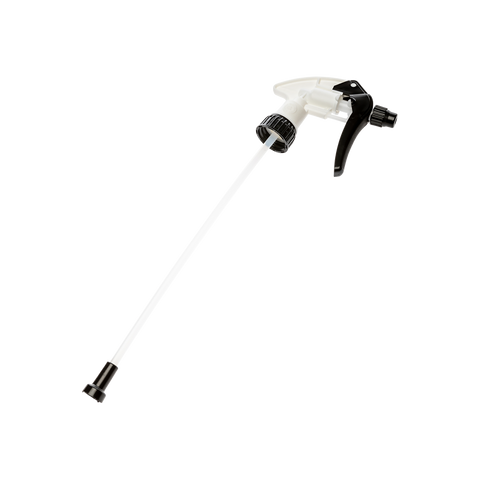
A hand spray head is a small piston pump. Each pull of the trigger pushes a fixed amount through the nozzle, then the pressure drops back to zero. So the spray pattern varies with how hard you squeeze: pull through briskly and you get a fine mist; press slowly and you put down coarse droplets that run straight down.
A pressure sprayer separates building pressure from delivering it. You pump air into the container, and the stored pressure pushes the liquid steadily through the nozzle as long as you hold the lever. The mist stays equally fine across the whole surface, because it's the pressure in the tank that sets the dose, not your hand.
Droplet size also differs between the two systems. A fine mist covers more area per millilitre and clings better; a coarse jet carries further and hits windows, tyres and the floor along the way. That overspray is wasted product, and with strong products it's also why rubber seals and trim get contact they don't need.
Evenness isn't cosmetic, it's what drives consumption. Where a trigger goes on patchy, you see dry zones and spray again, and every extra spray partly lands on areas that were already wet. From what we see day-to-day, that's the most common reason a litre of concentrate runs out faster than you'd worked out.
Then there's dwell time. A cleaner that works for three minutes in one spot and thirty seconds in the next gives you a blotchy result and calls for a second round. A film applied evenly starts working everywhere at once, and you rinse off after one pass.
The third point is your wrist. A bonnet takes a few pulls of the trigger. A full pre-wash with four wheels, sills and both sides takes several hundred, and the last of them are noticeably weaker than the first.
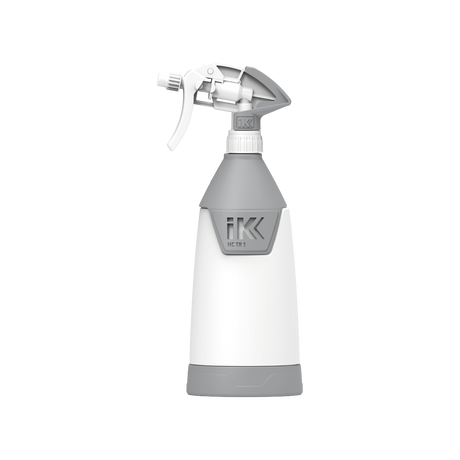
For quick detailers, interior cleaners and anything that goes onto small areas in portions, the classic car spray bottle is still the most direct tool.
The standard in detailing is 28/400. The numbers describe the neck thread: 28 millimetres outside diameter, with 400 identifying the thread profile. In plain terms, bottles and spray heads from different manufacturers fit together as long as both follow this standard. So you're not tied to one system.
The Koch-Chemie HDPE Cylinder Bottle (28/400) Spray Bottle 1000ml is our best-selling empty bottle of this type. With HDPE and PET bottles, check the manufacturer's approval for the specific product and its concentration. Even with the right thread, whether bottle and spray head are suitable is part of the choice.
The spray head is the wear part, not the bottle. You can buy the Koch-Chemie Spray Head „Star" (28/400) CHS-3AN by Canyon separately and fit it on any bottle with a matching thread. The tell-tale sign: when the spray breaks up or the pump sticks, you swap the head and keep the bottle.
On the head itself you usually have three settings: closed, focused jet and fine mist. For interior surfaces, use the mist and spray onto the towel rather than the trim, so nothing runs into switches and gaps. The jet is for spots you want to hit precisely, such as door shuts, hinges and the fuel flap.
Inside the car, the iK Sprayers „iK Multi" TR Mini 360º small spray bottle (28/400) is nicer to work with. Its 360-degree valve sprays upside down too, so you can get under the dashboard, into door pockets and along the headliner edge without tilting the bottle.
The hand bottle hits its limit with surface area. As soon as a whole car needs wetting, you're fighting the pump more than the dirt. Empty bottles, replacement heads and pre-filled versions are under Spray bottles.
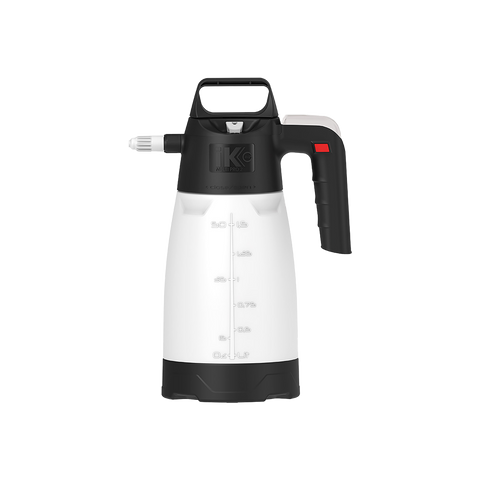
As soon as there's more than one panel to wet, the pressure sprayer comes into its own: pump it up once, then spray continuously without your hand doing the dosing.
Air is held under pressure in the container, with a safety valve capping it. As long as the pressure stays in the working range, the spray cone doesn't change. When the spray starts to falter, you know it's time to pump again — and you keep control over how much actually lands on the paint.
The iK Sprayers „iK Multi" Pro 2 Pressure Sprayer (incl. colour coding) is the classic of the two-litre class, and that's enough for pre-cleaner, bug remover or wheel cleaner on one car. The colour coding in the box permanently assigns one product to each sprayer.
The version with an all-round valve goes a step further. The iK Sprayers „iK Multi" Pro 2 360° pressure sprayer (with colour coding) sprays in any position, even upside down. You can reach wheel arches, the underside of sills and door entries without contorting yourself or keeping the container upright.
If you want a simple design that's easy to service, grab the solo CLEANLine (304 A / B) Pump Sprayer 2 Litres. Seal kits and spare parts for the CLEANLine are sold individually, which extends its service life instead of you replacing the whole sprayer over one perished O-ring.
Typical jobs are pre-cleaner along the whole side of the car, bug remover on the front and mirrors, wheel cleaner on all four wheels in one go. You'll find every design, from the two-litre hand pump to the big compressor model, under Pressure sprayers.
A foam sprayer mixes air into a suitable solution; for that it needs a foaming product at the dilution recommended by the chemical manufacturer.
Technically, this happens at a fine mesh or screen just before the outlet. The liquid gets swirled up there and pulls air along with it, multiplying the volume. For you, that means: a few millilitres of concentrate become a blanket of foam that works just as long on the door as on the horizontal bonnet.
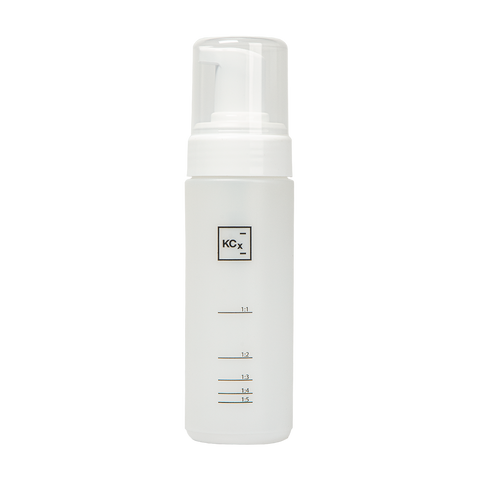
For the interior and for leather, the Koch-Chemie Foamer Bottle is the metered solution. The foam comes out of the bottle dry and controlled, doesn't drip into seams or electrics, and can be worked straight in with a brush without soaking the upholstery.
For exterior surfaces, the iK Sprayers „iK Foam" Pro 2 Pump Foam Sprayer (incl. colour coding) works with stored pressure and lays down a much thicker coat. The solo CLEANLine „VARIOfoam" (304 FA / FB) — 2 Litre Foam Sprayer also lets you adjust the consistency, from wet to dry.
One distinction we often have to clear up: a pump foam sprayer doesn't replace a foam lance on a pressure washer. The lance creates foam from water pressure and covers a whole car in no time. You'll find the right cleaner for that under Snow Foam.
The pump foam sprayer comes into its own where there's no pressure washer, or where you're working on specific spots: individual wheels, the bug-splattered front end, door sills, fabric upholstery. Every type, from the hand dispenser to the pressure unit, is under Foam Sprayer.
The most common failure isn't a broken pump but a seal that the chemistry in the container has swollen or hardened.
Three materials share the field. NBR stands for nitrile rubber; the material name alone isn't an approval for any cleaner. With EPDM, too, suitability for the specific formula and concentration needs checking. FKM, known by the trade name Viton, isn't a universal approval for acids or solvents either. Day to day, what you can fill it with comes down to the whole sprayer's approval for the specific product and its concentration.
That's why manufacturers offer several versions of the same sprayer, one for acidic and one for strongly alkaline products. From the outside they look almost identical; inside they differ in seals, O-rings and dip tube. Grab the wrong version and you'll only notice weeks later.
The decline happens in stages. First the seal swells and the pump gets stiff. Then it hardens, the container stops holding pressure and the sprayer hisses when you put it down. Finally the outlet drips, and the spray cone breaks up into individual jets because the nozzle is fed unevenly.
What we see again and again at Detailing1: solvent-based tar removers and strongly acidic wheel cleaners end up in a basic hand bottle because it happened to be within reach. No application system is resistant to everything. Also stick to the temperature and storage conditions in the specific manufacturer's instructions.
The routine to prevent it is simple: check the cleaner's compatibility information before filling, rinse with clean water after use and release the pressure. Which products fall into which group in the first place is sorted by pH and use in the overview under Cleaning.
The decision comes down to three questions: how big is the area, how long should the product stay put there, and what chemistry are you filling it with?
If you work on individual spots, a bottle with a replaceable head is the cheapest way to go. The Koch-Chemie HDPE Cylinder Bottle (28/400) Spray Bottle 1000ml and the Koch-Chemie Spray Head „Star" (28/400) CHS-3AN by Canyon together make a system you can refit as often as you like.
As soon as you're wetting a whole car in one go, switching to stored pressure pays off. The iK Sprayers „iK Multi" Pro 2 Pressure Sprayer (incl. colour coding) covers the standard case, and the 360-degree version also handles anything you spray overhead or from below.
If it's about contact time on vertical panels, foam is the way to go. The iK Sprayers „iK Foam" Pro 2 Pump Foam Sprayer (incl. colour coding) is the direct way in, and the solo CLEANLine „VARIOfoam" (304 FA / FB) — 2 Litre Foam Sprayer the pick if you want to adjust the consistency to suit the job.
Inside the car, keep it small and dry. The Koch-Chemie Foamer Bottle for leather and upholstery, plus the iK Sprayers „iK Multi" TR Mini 360º small spray bottle (28/400) for plastic and hard-to-reach edges. Both dose so sparingly that nothing runs behind the trim.
If you run several products side by side, think in sets rather than single sprayers: one for acidic, one for alkaline, one for the quick sealant, each colour-coded. The solo CLEANLine (304 A / B) Pump Sprayer 2 Litres is the serviceable base for that. The three sub-categories are under Spray bottles, Pressure sprayers and Foam Sprayer.
Too much choice in Spraying & foaming? Get help picking:
Daniel von Detailing1 |

Daniel von Detailing1 |

Daniel von Detailing1 |

Daniel von Detailing1 |

Daniel von Detailing1 |

Daniel von Detailing1 |

Daniel von Detailing1 |

Daniel von Detailing1 |

Jasper von Detailing1 |

Daniel von Detailing1 |

Daniel von Detailing1 |

Daniel von Detailing1 |