



How to spot genuine leather in your car: why the water drop isn't enough
Daniel von Detailing1 |


iK Sprayers "iK HC" TR 1 Spray Bottle for Solvents (28/400) - 1 Liter is on backorder. As soon as everything in your order is back in stock, we ship it all in one go — delivery time follows whichever item takes longest.
— Ready for immediate dispatch, delivery time 1-4 days
Item added to your cart.
View cart


Do you have any questions or need help?
We are sure that our help page will help you. There you will find information on how to contact us and the relevant answers to frequently asked questions.
Didn't find what you were looking for? Write us a message in the chat.
Shipping to Belgium from € 6,90 with Bpost, DPD or FedEx, delivery time 1-4 days. Orders from € 179 ship free with DPD.
All shipping methods, weight tiers and express options are listed in our shipping policy.
Car Care Store in Nordhorn
Why wait when you can get it fast? Order your car care products from us online and choose between convenient pickup or our lightning-fast delivery, whether locally or throughout Europe. We are dedicated to offering you maximum flexibility and convenience so your car always stays in top condition.
You can always pick up your order from Tuesday to Friday, 10:00 to 17:00, at Bosinks Kamp 8 in 48531 Nordhorn at Detailing1. Please have your pickup confirmation ready. We look forward to your visit.
Couldn't load pickup availability

What is the "iK HC" TR 1? A trigger spray bottle with 1 litre of usable capacity whose tank, seals and atomiser nozzle are built for hydrocarbon solvents, oils, petroleum products and alcohols. It is not built for strong acids, or for cleaners that sit in the tank alkaline for weeks.
"iK HC" TR 1 is a spray bottle for solvents from iK Sprayers, the sprayer brand of the Spanish Goizper group. From the outside it looks like any other trigger bottle; inside it is a different build. Tank plastic, the seals in the pump head and the dip tube are matched to grease-cutting chemistry — exactly the three parts a standard bottle gives up on first.
The failure always runs the same way. First the stroke goes soft because the seal in the piston swells. Then the head loses its pressure point and the bottle starts dripping on the shelf. In the end the nozzle corrodes and the spray pattern frays into a jet. Acetone is the fastest route there, because it pulls the plasticisers out of soft plastics and rubber — and acetone is exactly what the maker rates as optimal for the HC TR 1 in the leaflet.
Day-to-day from Detailing1: The expensive mistake is not the wrong bottle, it is the shared one. Pour an alkaline wheel cleaner into the same HC you just used for tar remover and you mix two chemistries in the dip tube, and the seal sees both. We get asked about exactly this: more product runs down the bottle than lands on the panel. The fix takes a minute: after every job pump about 100 ml of clean water through until the mist has no smell left, then unscrew the head and let it dry open. And actually label the flip card — people ask us for pre-printed cards regularly, because mixing bottles up on the shelf is the number one annoyance.
You fill the HC TR 1 neat or as a dilution, screw the head on and work without priming — the trigger builds the pressure on every pull. The rest is upkeep, and upkeep decides how long it lives.
The nozzle turns steplessly from a closed jet to a fine conical mist. For panel wipe and silicone removal before painting you want the mist, because you are after an even thin film and no runs down the flank.
For tar on the sill edge or grease in the engine bay you turn towards the jet. It carries further, lands where you aim it and stays put while it dwells. There is barely a quarter turn between the two extremes, so you correct while you work without taking the head off.
After the job the maker's instruction is literal: release the residual pressure, rinse the tank with clean water, pump the head dry with fresh water. A blocked nozzle is cleared with water only, never with wire or a needle — the orifice is the part that makes the spray pattern, and a scratch in it stays.
A little grease on the moving parts twice a year buys you seal life. Storage is frost-free between 5 and 30 °C. Below that the plastic goes brittle, above it the seals age faster.
One thing we would add that is in no manual: don't just rinse the tank, pump the head empty too. Several millilitres of solvent stay behind in the dip tube and the pump chamber after you tip the bottle out — and those keep working on the seal overnight while the tank is long since clean.
The iK Sprayers compatibility table has three levels: optimal, limited, not valid. The HC TR 1 sits on optimal for solvents, oils, petroleum products and alcohols — and on limited for alkalis and ketones.
That "limited" carries a footnote almost every retailer text drops: for acetone, itself a ketone, the maker explicitly rates the HC TR 1 as optimal in the leaflet. In practice that means acetone, brake cleaner, tar and adhesive removers, isopropanol as panel wipe, penetrating oil and chain lube residue are this bottle's core. Alkaline cleaners and ammonia solutions you can run through briefly, but you should not leave them sitting in it for days.
Then the limits that stay. Neither trigger bottle in this range is meant for acids: the "iK Multi" TR 1 is capped at diluted acid up to five percent, and the HC is not the acid type at all. If you want to decant an acidic iron remover, you need different kit.
The second limit is the trigger itself, not the tank. It clips onto the housing with two lugs and turns up regularly in retailer reviews as the part that breaks first. That is no argument against the bottle, it only changes what you order when something gives: the head, not the whole unit.
The third is plain ergonomics. A litre is hand work — for a full engine bay or a fleet, the pull on the trigger is what slows you down after twenty minutes. That is what pump sprayers with stored pressure are for.
In the end it is an if-then call. If hydrocarbons, acetone or alcohol are going in, the HC TR 1 is right. If instead car shampoo, interior cleaner, disinfectant or an alkaline all-purpose cleaner will live in it, grab the black multi-purpose spray bottle from the same range.
A spray bottle for solvents pays off for anyone with more than one product open at a time: detailers, spanner-turners with a full shelf, keen DIYers running a range rather than a single tin. If you use exactly one cleaner and spray it from its own bottle, you don't need it.
The reason is residual chemistry, and it is the heart of what we recommend: one bottle per product group — one for paint, one for wheels, one for the interior. Not out of tidiness, but because there is always a bit of the previous product left in the dip tube and the pump chamber.
The HC tank extends that logic downwards. It is the bottle for the aggressive end of the shelf, while the Multi version covers the neutral-to-alkaline everyday work. Two bottles, two head colours: the HC wears a grey head with a white lever, the Multi a black one. That is how you spot them on the shelf without reading the label — and the type designation HC TR 1 is moulded straight into the grey collar.
For the first fill, the obvious pick is what the maker built it for: a solvent-based tar remover for sills, arches and the lower door area. After that the bottle sits on the shelf with the flip card on red until there is bitumen on the paint again. If you are filling out your shelf, the neighbours are over in spray bottles.
The one thing no maker prints on the bottle: 28/400 is a measurement, not a chemical promise. The head off a multi-purpose bottle screws onto the HC tank perfectly — it just won't stand up to what's inside. So when you order a replacement head, the thread isn't what decides, the chemistry that will sit in it is. That is the thinking error that costs most heads: they fit, they just don't last.
Not sure about iK Sprayers "iK HC" TR 1 Spray Bottle for Solvents (28/400)? Get it explained:
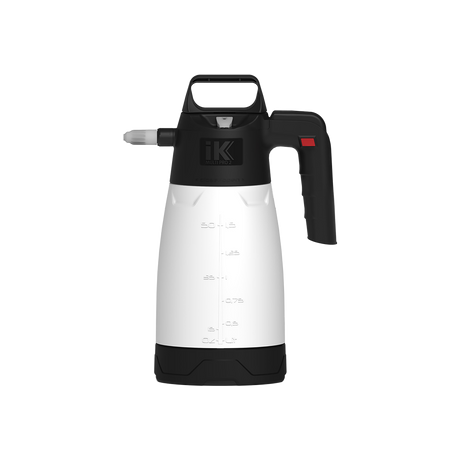
A trigger spray bottle from iK Sprayers with 1 litre of usable capacity, whose tank, seals and atomiser nozzle are made from especially resistant plastics. The maker rates it optimal for hydrocarbon-based solvents, oils, petroleum products and alcohols. The head comes fitted. 28/400 neck, 0.19 kg empty, translucent tank with level indicator and a 50 ml scale.
The trigger is a small piston pump: every pull draws liquid up the dip tube and forces it through the nozzle. No priming needed. The conical nozzle turns steplessly from a closed jet to fine mist, with barely a quarter turn between the two.
The chemistry, not the shape. The HC TR 1 is built for hydrocarbon solvents, oils and alcohols; the multi-purpose spray bottle is for neutral, alkaline and disinfecting products plus diluted acid up to five percent. From outside you tell them apart by head colour: HC grey, Multi black.
The HC version for both. Oils of vegetable, animal and mineral origin sit on optimal, as do petroleum products, which is where hydrocarbon-based brake cleaner belongs. Tar remover, isopropanol as panel wipe and penetrating oil fall into the same bracket. It is not rated for strong acids.
Usually the nozzle is blocked. Clear it with clean water only, never with wire or a needle, because a scratch in the orifice ruins the spray pattern for good. If instead the stroke goes soft and the bottle drips, a seal has seen chemistry it was not built for.
Mechanically yes, chemically no. 28/400 is a plain measurement for diameter and thread pitch and says nothing about how the seals hold up. A head off a multi-purpose bottle screws on cleanly but won't stand up to the solvent inside long term. Decide by contents, not by thread.
Fill the tank neat or as a dilution. The moulded scale on the translucent body runs in 50 ml steps, so you can mix a concentrate straight in the bottle without a measuring jug. Screw the head on hand-tight — the 28/400 thread needs no force, and over-tightening only warps the sealing face.
No priming needed: the trigger builds pressure on every pull. The nozzle turns steplessly from a closed jet to a fine conical mist, with barely a quarter turn between the two ends. Mist for panel wipe and silicone removal before painting, jet for tar on the sill edge and grease in the engine bay.
After the job, release the residual pressure, rinse the tank with clean water and then pump about 100 ml of water through the head until the mist has no smell left. This is the step most people skip: several millilitres of solvent otherwise stay in the dip tube and the pump chamber and keep working on the seal overnight. Then unscrew the head and let it dry open.
Clear a blocked nozzle with water only, never with wire or a needle — the orifice makes the spray pattern and a scratch in it stays. For shelf order, the red-and-green flip card that comes with it sits on the collar; label it rather than trusting your memory. Replacement heads in 28/400 are over in spray bottles.
Notes: The HC TR 1 is built for hydrocarbon-based solvents, oils, petroleum products and alcohols; the maker explicitly rates acetone as optimal. Alkaline cleaners and ammonia solutions you can run through briefly, but don't leave them sitting in it — that is what the multi-purpose spray bottle from the same range is for. Neither trigger bottle is rated for strong acids. Use one bottle per product group, because there is always a bit of the previous product in the dip tube. A little grease on the moving parts twice a year buys you seal life. Store frost-free between 5 and 30 °C and without pressure.
Contact
Goizper Central Europe B.V.
Ambachtsweg 4, 4854 MK Bavel, Niederlande
https://iksprayers.com
Choose from many payment methods such as PayPal, Bancontact, iDEAL, Klarna, Apple Pay, Mastercard or Visa and benefit from pay later and instalment options. Your payment details are always processed securely. Questions about payment?
Your order reaches you from € 6,90 in 1-4 days with Bpost, DPD or FedEx. Orders from € 179 ship free with DPD. Questions about shipping?


iK Sprayers
iK Sprayers "iK Multi" TR 1 360° Sprayer (28/400)
Professional sprayer for versatile applications with 360° spraying


iK Sprayers
"iK e Foam" Pro 2 Electric Battery Foam Sprayer (built-in battery compressor)
Electric foam sprayer with high-quality foam
iK Sprayers
"iK Foam" Pro 2+ (Plus) Pump Foam Sprayer with Compressor Valve (incl. Colour Coding)
Professional pump foam sprayer for versatile cleaning tasks
iK Sprayers
"iK Foam" Pro 2 Pump Foam Sprayer (incl. colour coding)
Professional foam sprayer for versatile car care
iK Sprayers
"iK Multi" TR Mini 360º small spray bottle (28/400)
Efficient Spray Solution for Versatile Applications
iK Sprayers
"iK Multi" Pro 2 360° pressure sprayer (with colour coding)
Professional 360° pressure pump sprayer for versatile use
iK Sprayers
"iK Multi" TR 1 Spray Bottle (28/400)
Versatile and robust spray bottle for car care professionals
iK Sprayers
"iK Multi" Pro 2 Pressure Sprayer (incl. colour coding)
Resistant pressure sprayer
iK Sprayers
"iK Foam" 1.5 Pump Foam Sprayer
Professional Foam Sprayer for Car Care
iK Sprayers
"iK e Foam" Pro 12 Electric Pump Foam Sprayer (compressor included)
High-Capacity Electric Foam Sprayer with Versatile Foam
iK Sprayers
Spray Head "iK Trigger" Multi TR 1 360º (28/400) CHS-3AN by Canyon
Efficient car care with precise distribution and 360° design
iK Sprayers
"iK Multi" Pro 12+ (Plus) Pressure Sprayer with Compressor Valve (incl. Colour Coding)
Perfect pressure pump sprayer for professional car care
Daniel von Detailing1 |

Jasper von Detailing1 |

Jasper von Detailing1 |

Daniel von Detailing1 |

Daniel von Detailing1 |

Daniel von Detailing1 |

Daniel von Detailing1 |

Daniel von Detailing1 |

Daniel von Detailing1 |

Daniel von Detailing1 |

Daniel von Detailing1 |

Daniel von Detailing1 |